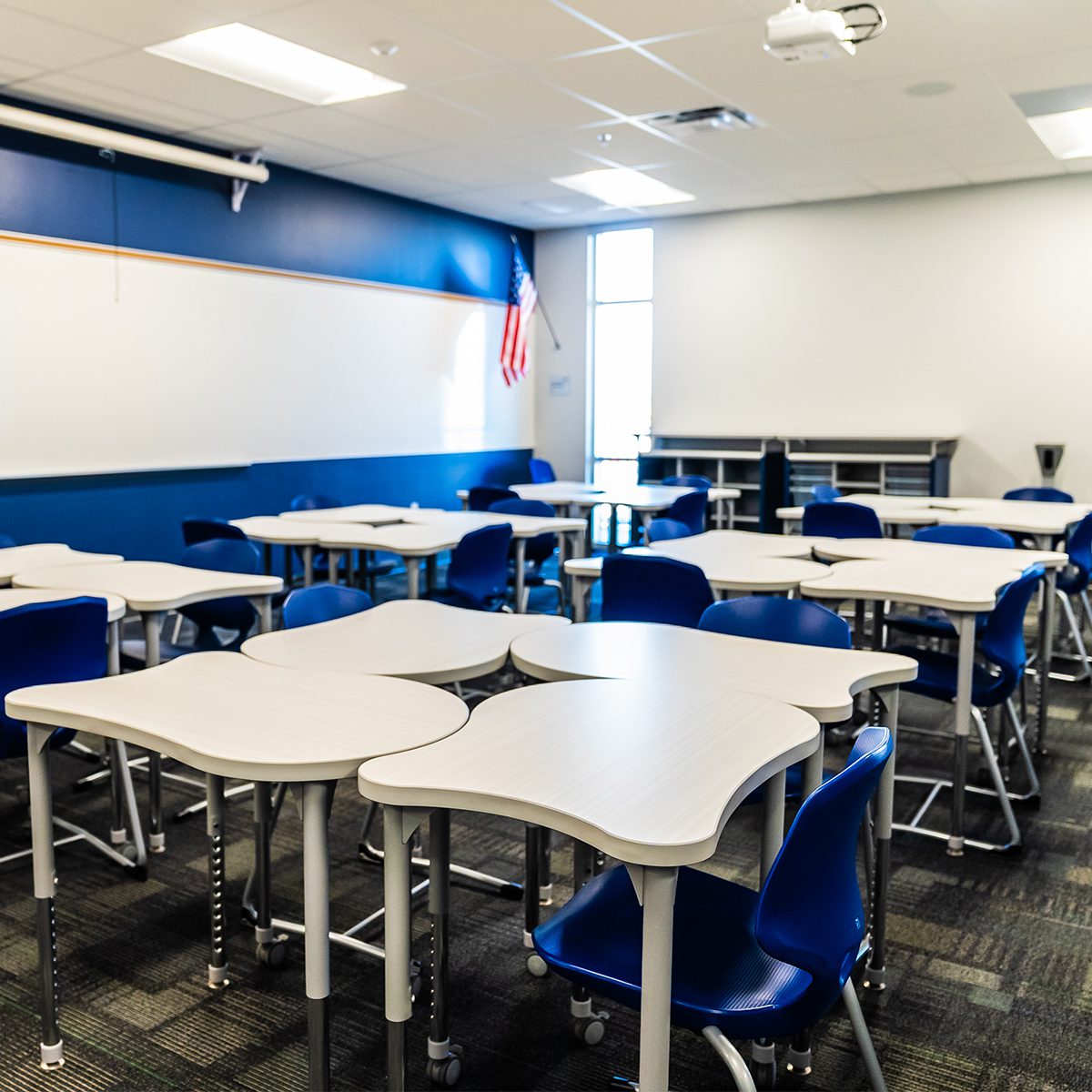
Why Ergonomic Classroom Furniture Matters for Student Health
Students spend the majority of the school day seated, in furniture they did not choose, sized for a grade level rather than for them individually.
Ergonomics tends to get treated as a premium feature, something to consider if budget allows. That gets it backward. Ergonomics is not a product tier. It is the relationship between a student’s body and the surfaces they sit on and work at, determined at specification long before anyone sits down.
According to an independent 2025 industry survey, 73% of stakeholders say the physical learning environment is extremely or very important to student learning [1]. Fit is the most basic version of that. A student who cannot reach the floor or cannot get close enough to the work surface is being inhibited by their furniture rather than supported by it.
This guide covers what ergonomics actually means in a classroom, what the research does and does not establish, and the specification and budget decisions that determine whether the district receives the best solution. The recommendations reflect how Meteor Education approaches learning environment specification across K-12 districts, with a focus on creating safe and comfortable learning spaces for all students.
What “Ergonomic” Actually Means in a Classroom
Ergonomic is not a product category, and it is not a claim that can be made about a product on its own. A chair can only be ergonomic relative to the person sitting in it. The same chair that fits a 5th grader well can be the wrong chair for a 5th grader who is six inches taller.
Four fit relationships do most of the work:
| Fit Point | What It Compares | What Happens When It Is Wrong |
|---|---|---|
| Seat height | Seat surface to the back of the knee when the foot is flat on the floor | Too high and the feet dangle, putting pressure on the underside of the thigh. Too low and the knees rise, shifting load to the lower back. |
| Seat depth | Seat front-to-back against the length of the thigh | Too deep and the student slides forward to relieve pressure behind the knee, losing back support entirely. |
| Work surface height | Desk or table height against seated elbow height | Too high and the shoulders lift. Too low and the student leans forward into a sustained flexed posture. |
| Back support | Backrest shape and height against the spine and shoulder blades | Without usable support, the torso works to hold position through the entire class period. |
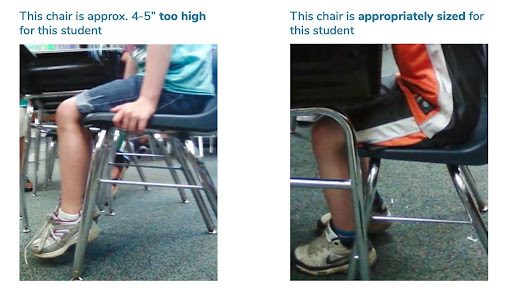
Seat height in practice. When a chair is correctly sized, the student’s feet rest easily on the floor with ankles, knees, and hips at about 90 degrees.
These are the reasons furniture comes in size ranges, and the reason a single size per building creates problems. Meteor Education specializes in creating safe, comfortable, and inclusive K–12 learning environments, and treats these fit relationships as specification inputs rather than product features.
The Fit Problem Is Larger Than Most Districts Assume
Studies measuring students against the furniture they actually use have found mismatch to be the norm rather than the exception, across a range of countries and grade levels.
A U.S. study of middle school students in a Michigan district compared individual body measurements against the chairs and desks in their classrooms and found that very few students were well matched to the furniture available to them [2]. That study was small, but its findings are consistent with a large international literature reporting high mismatch rates for seat height, seat depth, and desk height.
Furniture is typically specified by grade band, and the range of body sizes within a single grade is wide. Any single size will fit the middle of that range and fail at both ends. The students at the extremes are the ones sitting in furniture that does not work for them all year. Students are also growing throughout the year, at different rates and at different times. Unlike adults, whose measurements are essentially fixed, a sixth grader may be noticeably taller in June than when the school year started. A size that fits in September may not fit by spring, which is part of why adjustability matters more in a classroom than it does in an office.
An honest note on the evidence
Pain in school-aged children has many contributing factors, including backpack use, screen time, activity levels, and growth. Furniture is one factor among several, and districts should be skeptical of anyone claiming furniture alone will resolve student discomfort. What the evidence supports is narrower and still worth acting on: fit affects posture and reported comfort, and mismatch is common enough that many students are experiencing it.
Movement Matters as Much as Fit
A perfectly fitted chair still holds a student in one position. Sustained static posture is its own problem, and no single seat solves it.
Research on stand-biased and sit-to-stand desks in schools is among the more developed areas in this literature. A systematic review of school-based standing desk interventions concluded that the available evidence supports integrating standing desks into classrooms as a way to reduce sitting time and increase standing time among elementary students, while noting that effects on academic performance are not established [3]. A separate year-long study in a Grade 4 classroom found that students using standing desks were less likely to report neck and shoulder discomfort, and that the effect held after the novelty period passed [4].
The takeaway is not that every classroom needs standing desks. Postural variety is part of the ergonomic answer, and a room offering more than one working posture does something a single fixed seat cannot.
The Specification Decisions That Determine Fit
Fit is won or lost in the specification, not in the product brochure. Meteor Education offers extensive product selection through 240+ manufacturer partners, which is what makes ordering across a size range practical rather than theoretical. These are the decisions that matter:
| Decision | Why It Matters |
|---|---|
| Size range per building | Ordering one size per grade band is the most common source of mismatch. Ordering across a range, or specifying adjustable pieces, covers the students at both ends of the distribution. |
| Height adjustability | Adjustable chairs and tables absorb variation within a room and extend usable life as students grow or the room changes grade assignment. |
| Posture variety in the room | A mix that allows sitting, perching, and standing gives students and teachers options during long blocks. |
| Safety and durability standards | ANSI/BIFMA X6.1 is the U.S. safety, durability, and structural standard for educational seating [5]. It addresses whether a chair holds up, not whether it fits a given student. Districts should ask about both. |
| Accessibility and inclusion | Fit considerations extend to students using mobility devices, students with sensory needs, and students whose measurements fall well outside the grade-band average. |
| Replacement and matching | Sizing decisions made now need to be repeatable in later phases so a district does not end up with incompatible inventory across buildings. |
Educator input sharpens all of these. Teachers know which students are perched on the edge of a chair and which are hunched over a desk, and that knowledge belongs in the specification conversation rather than after delivery. This is part of the broader case for designing learning spaces with educators rather than for them.
Meteor Education’s Collaborative Design process brings that knowledge into the specification, and Meteor Education designs specialized learning environments for special education, including adaptive and sensory-supportive spaces.
Budget for Ergonomics at the Start, Not at the End
Adjustability, size variety, and posture options all cost more than a single fixed size ordered in bulk. They are also, predictably, the first things removed when the furniture budget is set late and comes in short.
Do not wait to build the furniture budget until the last minute. It should be accounted for at the very beginning of the project.
When furniture budgets are set late, districts may have fewer options for adjustability, size variety, and consistent standards across buildings.
How this maps to bond cycles
Bond programs are publicly announced during the approval process and funded across a multi-year window, with districts typically reaching purchase-ready status well after passage. Districts that set the furniture line early in that window get three things:
- Room in the budget for adjustability and size range rather than a single default size
- Consistent sizing standards across every school in the program, so students transferring or advancing encounter the same environment
- Time to pilot a configuration and check fit in a real classroom before committing the full program
Meteor Education helps districts budget classroom furniture early in the bond cycle and offers Pilot Programs so a district can check fit in a real classroom before committing the full program.
Late planning produces the opposite: single-room purchases, inconsistent sizing between buildings, and no mechanism to correct fit once the furniture is in place.
It is also worth assessing the utility and educational value of existing furniture rather than assuming. Some of it may fit the students using it well enough to keep, which frees budget for the rooms and grade levels where fit is genuinely failing. Meteor’s Current Environment Assessment evaluates what a district already has, identifying which pieces still serve students well and which spaces need change.
A Note for Architects and Design Firms
Furniture fit is constrained by decisions made in schematic design, before any product is selected:
- Casework and built-in work surface heights are effectively permanent, and a fixed height that suits one grade band will not suit another when the room is reassigned
- Floor finishes affect stability, noise, and whether mobile or motion seating is practical
- Power and data locations determine whether height-adjustable and reconfigurable furniture can actually be used as intended
- Room proportions determine whether a range of seating heights fits without creating sightline problems
Treating FF&E as a primary planning line item, rather than a residual, is what allows fit to be designed rather than inherited. Meteor Education partners with architects and design firms on K–12 FF&E planning and provides AIA-accredited CEU programs.
Getting Full Value From Adjustable Furniture
Purchasing adjustable furniture does not on its own mean it will be used effectively. Getting the full benefit from ergonomic and adjustable furniture takes a few things:
- Teachers need to know how to adjust the furniture and when to check it, particularly at the start of a school year
- Facilities staff need to know how sizing is assigned across rooms so pieces are not redistributed at random
- New hires need the same baseline orientation as everyone else
Meteor Education provides post-installation teacher support to maximize learning space effectiveness. Environment Orientation covers adjustment and configuration so the sizing plan survives past year one.
A Note on CTE and Lab Spaces
Ergonomics in career and technical education spaces is a different problem with higher stakes. Work is frequently done standing, at fixed-height benches and equipment stations, with reach, clearance, and line of sight governed by safety requirements rather than comfort.
The relevant considerations there are workstation height relative to the task, clearance around equipment, and instructor sightlines across the room. Applying a general-classroom seating standard to a lab does not work. For broader planning considerations in these environments, see the superintendent’s guide to future-proofing CTE for workforce demand.
What Districts Can Reasonably Measure
Districts should be careful about what they claim to measure here. A furniture partner is not in a position to report on student health outcomes, and furniture partners should avoid attributing student health outcomes directly to furniture alone.
What is observable in the learning environment is how the space is used:
- Whether students are using the full room or defaulting to one configuration
- Whether students are choosing seating and posture based on the task
- Frequency and quality of group work, student voice, and independent work
- Observable engagement and participation during instruction
Meteor’s Impact Report captures these observable behaviors as structured post-occupancy data. A baseline assessment before the project makes those observations meaningful afterward. Districts can pair environment observations with their own health, attendance, or performance data if they choose, but those remain district-tracked metrics, not furniture outcomes.
Questions to Ask Before Specifying
- What size range are we ordering, and what percentage of students at each grade level does it actually fit?
- Which pieces are height adjustable, and who is responsible for adjusting them?
- Does this room offer more than one working posture, or one fixed seated position?
- Are the seating products tested to ANSI/BIFMA X6.1, and what does that standard cover?
- How are students outside the average size range accommodated?
- Have we set the furniture and equipment budget line at the start of the project, or will it be whatever remains?
- Will sizing be consistent across every school in this program and repeatable in later phases?
- Who trains staff on adjustment and sizing, and when does that happen?
Fit Is a Specification Decision, Not a Furniture Upgrade
Ergonomics in a classroom is not about buying premium chairs. It is about ordering the right sizes, providing adjustability where variation is greatest, offering more than one working posture, and making sure the furniture continues to fit students well over the long term.
The groundwork for proper classroom ergonomics is often laid when the budget line is set and the specification is written.
Meteor Education partners with districts and design teams across the full project lifecycle, from early budget and assessment through design, installation, educator training, and post-occupancy measurement.
District leaders and design partners can speak with a Meteor Education expert to plan furniture that fits the students who will use it.
Frequently Asked Questions
The evidence is mixed. Several studies report associations between poor furniture fit and reported neck, shoulder, and back discomfort in students, while others find no significant association. Pain in school-aged children has multiple contributing factors. What is well documented is that mismatch between student body dimensions and classroom furniture is common, and that poor fit affects posture and reported comfort.
Research does support that stand-biased and sit-to-stand desks reduce sitting time and increase standing time among elementary students, and one year-long study reported fewer neck and shoulder discomfort reports. Districts should treat movement and posture variety as the documented benefit rather than claiming academic gains.
ANSI/BIFMA X6.1, Educational Seating, is the U.S. national consensus standard for the safety, durability, and structural adequacy of educational seating, covering products such as chairs, stools, chair desks, and convertible bench tables. It evaluates whether a product holds up under use. It does not determine whether a given chair fits a given student, which remains a specification decision.
Ready to transform your existing space into a dynamic learning hub that engages every student? Contact the K-12 learning environment experts at Meteor Education today to start a conversation and bring your vision to life.
Sources
[1] Independent 2025 industry survey.
[2] Parcells, C., Stommel, M., and Hubbard, R.P. “Mismatch of Classroom Furniture and Student Body Dimensions: Empirical Findings and Health Implications.” Journal of Adolescent Health, 24(4), 1999.
[3] “Classroom Standing Desks and Sedentary Behavior: A Systematic Review.”
[4] “Standing Desks in a Grade 4 Classroom over the Full School Year.”
[5] ANSI/BIFMA X6.1-2018, Educational Seating.
Get in touch
Find Your Local Studio
Meteor Education partners with schools to create collaborative spaces that accelerate engagement and empower educators.