Flexible Seating vs Traditional Classroom Furniture: How to Choose for Each Space
Flexible seating has become one of the most visible changes in K-12 classrooms.
Some district leaders view it as essential to modern instruction, while others look at wobble stools and wonder whether they are paying a premium for furniture that will be pushed against the wall by October. Both reactions contain something true. The practical questions are what a given space needs to support, and whether the furniture budget was set early enough for the district to make a real choice.
According to an independent 2025 industry survey, 73% of stakeholders say the physical learning environment is extremely or very important to student learning [1]. That makes the seating decision worth getting right, and worth planning rather than defaulting.
This guide compares the two approaches on the factors that drive the decision: instructional flexibility, ergonomic fit, classroom management, and long-term value. It also covers how to budget for the right approach before design decisions lock it in. The recommendations reflect how Meteor Education designs flexible learning classrooms for multiple teaching modalities.
Defining the Terms
These labels get used loosely, so it helps to be specific before comparing them.
Flexible seating
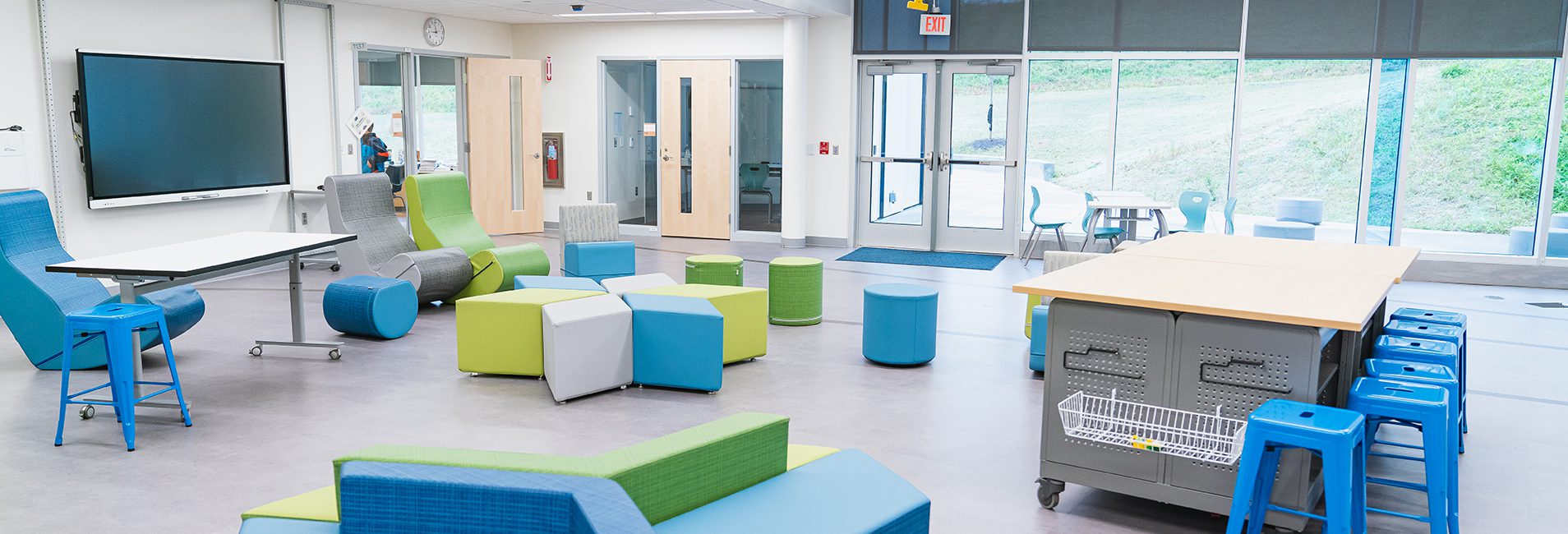
Mobile, reconfigurable seating that gives students and teachers options:
- Rocker and wobble stools
- Mobile task chairs on casters
- Soft seating
- Stools at varied heights
- Floor seating
- Standing-height options
All usually paired with mobile tables or desks that nest or reconfigure. The defining trait is mobility and choice. Meteor Education designs flexible learning classrooms, combining seating, tables, and storage into configurations a teacher can actually change between or during lessons.
Traditional classroom furniture
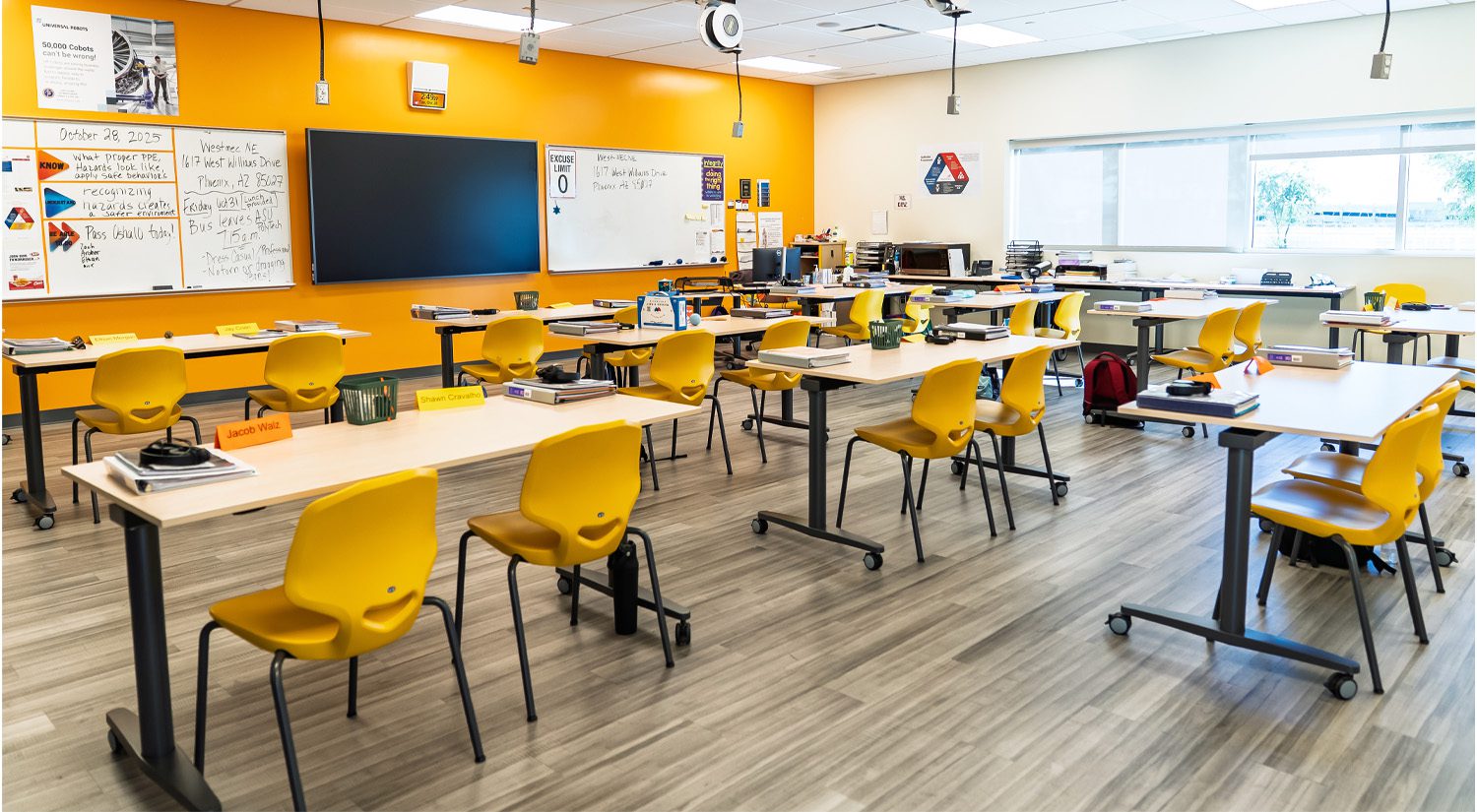
Fixed-height student chairs and desks, or chair-desk combination units, arranged in a repeatable and usually forward-facing layout. The defining trait is consistency: every seat is the same, every configuration is predictable, and the room resets to a known state. Meteor Education aligns learning spaces with curriculum and teaching methods.
The Tradeoffs Side by Side
The table below compares the two approaches across the factors that come up most often in planning conversations. Actual costs and service life vary significantly by manufacturer, product line, and specification, so districts should treat this as a framework rather than a price sheet. That variation is also why breadth of selection matters. Meteor Education offers extensive product selection through 240+ manufacturer partners, so districts can compare options across price points rather than within a single line.
| Factor | Flexible Seating | Traditional Furniture |
|---|---|---|
| Upfront cost | Available in a wide set of price ranges, from budget-conscious options to premium soft seating and height-adjustable pieces. | Available across a similar range of price points depending on specification and quality level. |
| Instructional flexibility | Supports fast transitions between whole-group, small-group, and independent work within a single period. | Efficient for direct instruction and independent work. Reconfiguration takes time and effort. |
| Durability and lifecycle | Quality K-12 specified flexible furniture carries warranties and replacement cycles comparable to traditional furniture. | Warranties and replacement cycles are comparable when specified for contract use. |
| Ergonomic fit | Multiple heights and postures accommodate a wider range of body sizes and needs in the same room. | One size per grade band, simple to specify, but a poorer fit at the ends of the range. |
| Classroom management | Teachers manage student choice, helping students select seating and work surfaces based on learning needs and ensuring equitable access. | Teachers manage a predetermined environment, with less to manage around choice and fewer opportunities for students to develop autonomy. |
| Storage and footprint | Varies. Nesting and stacking capability differs widely by piece, and some pieces do not store compactly. | Stacks and stores predictably. Storage needs are well understood by facilities staff. |
| Maintenance | Moving components and upholstery are covered by warranty and supported with replacement parts. | Routine hardware tightening and glide replacement. |
Both approaches require classroom management systems and structures. The difference is what those systems are designed to support. In flexible environments, teachers build structures around student choice, helping students understand how to select seating and work surfaces based on what they need as learners rather than treating flexible seating as a reward. In traditional configurations, seating is largely predetermined, so there is less to manage around choice and fewer opportunities for students to develop autonomy in selecting the environment that supports their learning. Research suggests flexible spaces work best when the physical environment is intentionally paired with student-centered practices that support autonomy and choice, rather than when flexible furniture is simply added to a room [3].
ANSI/BIFMA X6.1 is the U.S. national consensus standard for the safety, durability, and structural adequacy of educational seating, covering chairs, stools, chair desks, and convertible bench tables [2]. It evaluates whether a product holds up under use, not whether it fits a given student or supports a given instructional model. Districts should ask whether the seating under consideration has been tested to it.
Where Flexible Seating Delivers the Most Value
Flexible seating delivers the strongest return in spaces where the instructional model genuinely changes during the day:
- Classrooms that move between whole-group instruction, small-group work, and independent work within a single period
- Project-based, collaborative, and inquiry-driven programs where student grouping changes by task
- Libraries, media centers, commons, and shared collaborative areas serving many different users and activities
- Rooms shared across grade levels or programs, where a single fixed height serves no one well
- Spaces supporting sensory, mobility, or inclusion needs, where seating choice and movement are part of the instructional strategy
What these spaces share is a need to change. Meteor Education designs learning spaces that promote student collaboration and creates adaptable learning spaces for evolving instructional needs, which is the requirement a fixed configuration cannot meet.
A mixed-methods study of flexible seating in university classrooms found that nearly 80% of respondents reported a positive effect on their experience, clustering around four themes: movement opportunity, comfort and back pain, anxiety and restlessness, and focus and engagement [4]. The study was conducted in higher education at a single institution with a small sample, so it should be read as directional rather than conclusive for K-12.
The common thread is variability. When the same room has to do several jobs, furniture that can only do one becomes the constraint. This is also why educator input matters more than product selection. Designing around how teachers actually teach can help align furniture choices with instructional goals rather than starting with product selection alone. That is why Meteor’s Collaborative Design process pairs interior designers with experienced educators, so the design reflects instructional practice before anything is ordered, which is the case for designing learning spaces with educators rather than for them.
Where Traditional Furniture Still Makes Sense
Flexible seating is not automatically the better answer for every space:
- Rooms that are predominantly direct instruction or lecture based
- Dedicated testing environments where consistency and spacing requirements govern the layout
- High-traffic, high-turnover spaces with heavy daily use
- Rooms constrained by fixed technology, utilities, or casework that limit reconfiguration anyway
- Projects where budget is genuinely tight and the district would rather cover more classrooms at a functional level than fewer at a premium level
There is also a third option that gets overlooked. Furniture that is still structurally sound does not always need to be replaced. Reuse and refurbishment can free budget for the spaces where different seating would better support instruction. Meteor’s Current Environment Assessment evaluates what a district already has, identifying which pieces can be reused and which spaces genuinely need change.
Budget for Furniture Early, Not Last
The single most consequential factor in this decision is not preference. It is timing.
Furniture and equipment is frequently the last budget line to be set and the first to be cut. When the FF&E number is not established until construction pricing is settled, the seating decision has already been made by whatever is left over. Districts do not get to intentionally choose between flexible and traditional at that point.
Do not wait to build the furniture budget until the last minute. It should be accounted for at the very beginning of the project.
How this maps to bond cycles
Because bond programs must be publicly announced during the approval process, districts and their partners can plan against a known timeline. Bond funds are typically spent across a multi-year window, and districts often reach purchase-ready status in the middle years of that window rather than immediately after passage.
That gap is the opportunity. Districts that establish the FF&E line at or near bond passage get three things:
- A real choice between seating approaches, rather than a default determined by leftover funds
- Consistent standards applied across multiple sites and multiple phases of the program
- Time to pilot a configuration in one or two rooms before committing the full program to it
Meteor Education helps districts budget classroom furniture early in the bond cycle and offers Pilot Programs so a district can test a configuration in one or two rooms before committing the full program.
District standards streamline later purchasing decisions, keep replacement parts consistent, and mean a student transferring between schools encounters a comparable environment. Meteor Education provides turnkey, district-wide learning space solutions and helps districts establish standards that can be applied across multiple sites.
A Note for Architects and Design Firms
On new construction, the FF&E conversation often happens late, after the building budget has absorbed the available contingency. Treating furniture as a secondary line has a design consequence, not just a budget one.
Decisions made in schematic design constrain what seating can work later:
- Power and data locations determine whether mobile and reconfigurable furniture is actually usable
- Floor finishes affect caster performance, noise, and maintenance
- Casework, storage, and fixed elements set the effective floor area available for reconfiguration
- Room proportions and sightlines determine whether varied seating heights work or create obstructions
Elevating FF&E to a primary planning line item at schematic design avoids the late-stage compromise where flexible design intent meets a traditional furniture budget. It also gives the design team a clearer picture of what a full-service partner should be delivering; see what to expect from a turnkey K-12 furniture partner for the stages that should be included in a comprehensive engagement.
Adoption Determines the Outcome
When flexible seating disappoints a district, the cause is usually not the furniture.
Furniture alone does not change how a room gets used. Without instructional routines and staff confidence, a flexible classroom can settle back into rows within weeks. The causes are predictable, and most of them are about what happens after delivery:
- Teachers were not part of the design conversation and inherited a room they did not help shape
- No one was trained on how to reconfigure the space for different lesson types
- New hires and substitutes received no orientation to the space
- Training was treated as a delivery-day walkthrough rather than ongoing support
The fix is not more furniture. It is orientation, coaching, and reinforcement after installation. Meteor Education provides post-installation teacher support to maximize learning space effectiveness.
A study of flexible seating in university classrooms noted that instructors had received no training on how to use it to maximize its benefits, and recognized its value only instinctively [4]. That gap is where post-installation support makes the difference.
Planning for training alongside the furniture is what helps districts get the most from the investment.
Measuring Whether the Space Works
Seating decisions are testable. The evidence is in how the space is used, and it is observable.
| What to Observe | What It Tells You |
|---|---|
| Group work | Whether collaboration is happening, and how easily students form and reform groups |
| Student voice | How often students contribute, lead, and direct their own work |
| Autonomy | Whether students are choosing seating, tools, and workspaces based on the task |
| Use of space | Whether the full room is being used as designed or only one default configuration |
| Engagement indicators | Observable attention, participation, and body language during instruction |
Meteor’s Impact Report captures these behaviors as structured post-occupancy data.
A baseline observation before the project makes the comparison meaningful afterward. These measures describe how the learning environment is used, and districts can pair them with their own performance data. They are not a substitute for district-tracked academic metrics and should not be presented as one.
A Note on CTE and Lab Spaces
Career and technical education spaces follow different rules. Seating decisions there are subordinate to workflow, equipment placement, safety clearances, and utility locations.
In most CTE environments the practical answer is zoned rather than uniform: durable and often fixed positions at equipment stations, with flexible furniture reserved for the instruction, planning, and collaboration areas of the room. Applying a general-classroom seating standard to a lab is a common and expensive mistake.
For the broader planning considerations in these spaces, see the superintendent’s guide to future-proofing CTE for workforce demand.
Questions to Ask Before Choosing an Approach
Use these during planning meetings, RFP development, or vendor interviews:
- What instructional modalities does this space need to support within a single class period?
- Have we set the furniture and equipment budget line at the start of the project, or will it be whatever remains?
- What is the expected service life of each piece type, and what is the replacement path?
- Will we still be able to buy matching pieces in later phases of this program?
- Which existing furniture can be reused or refurbished so budget goes where it better supports instruction?
- Is this approach a district-wide standard, or a one-room decision that will be difficult to repeat?
- Who is training staff on the new configuration, and when?
- How will we observe and document whether the space is being used as designed?
Plan It Early, Support It Well
Flexible seating is not inherently better. To best support students and teachers, it should be intentionally planned into the budget, designed with educators, and supported with training after installation.
The decision that separates strong projects from disappointing ones happens earlier than most districts expect. Set the furniture line at the beginning, decide the approach as a district-wide standard rather than a room-by-room reaction, and plan for training and measurement alongside the purchase.
Meteor Education partners with districts and design teams to plan learning environments from early budget through design, installation, educator training, and post-occupancy measurement.
District leaders and design partners can speak with a Meteor Education expert to plan the right furniture strategy for an upcoming project.
Frequently Asked Questions
There is no universal ratio. The right proportion depends on how the room is actually taught in, which modalities it needs to support, and what the instructional program requires. Meteor Education designs flexible learning classrooms for multiple teaching modalities and can assess a specific room against how it is used.
Furniture can create the conditions for different instructional practices. Districts that pair new environments with educator involvement in design and post-installation training may see better adoption rates.
At the beginning. Establishing the furniture and equipment line early, rather than after construction pricing settles, is what preserves an actual choice between approaches and allows consistent standards across multiple sites and phases.
Ready to transform your existing space into a dynamic learning hub that engages every student? Contact the K-12 learning environment experts at Meteor Education today to start a conversation and bring your vision to life.
Sources:
[1] Independent 2025 industry survey.
[2] ANSI/BIFMA X6.1-2018, Educational Seating.
[3] Kariippanon, K.E., et al. Studies on flexible learning spaces, student autonomy, and engagement, 2019 and 2021; Attai, S.L., et al., 2021.
[4] Pennington, C., Putman, R.S., and Munsey, B.A. “An examination of flexible seating in the higher education classroom from a physical and kinesthetic perspective.” Journal of Learning Spaces, 11(2), 2022.
Get in touch
Find Your Local Studio
Meteor Education partners with schools to create collaborative spaces that accelerate engagement and empower educators.