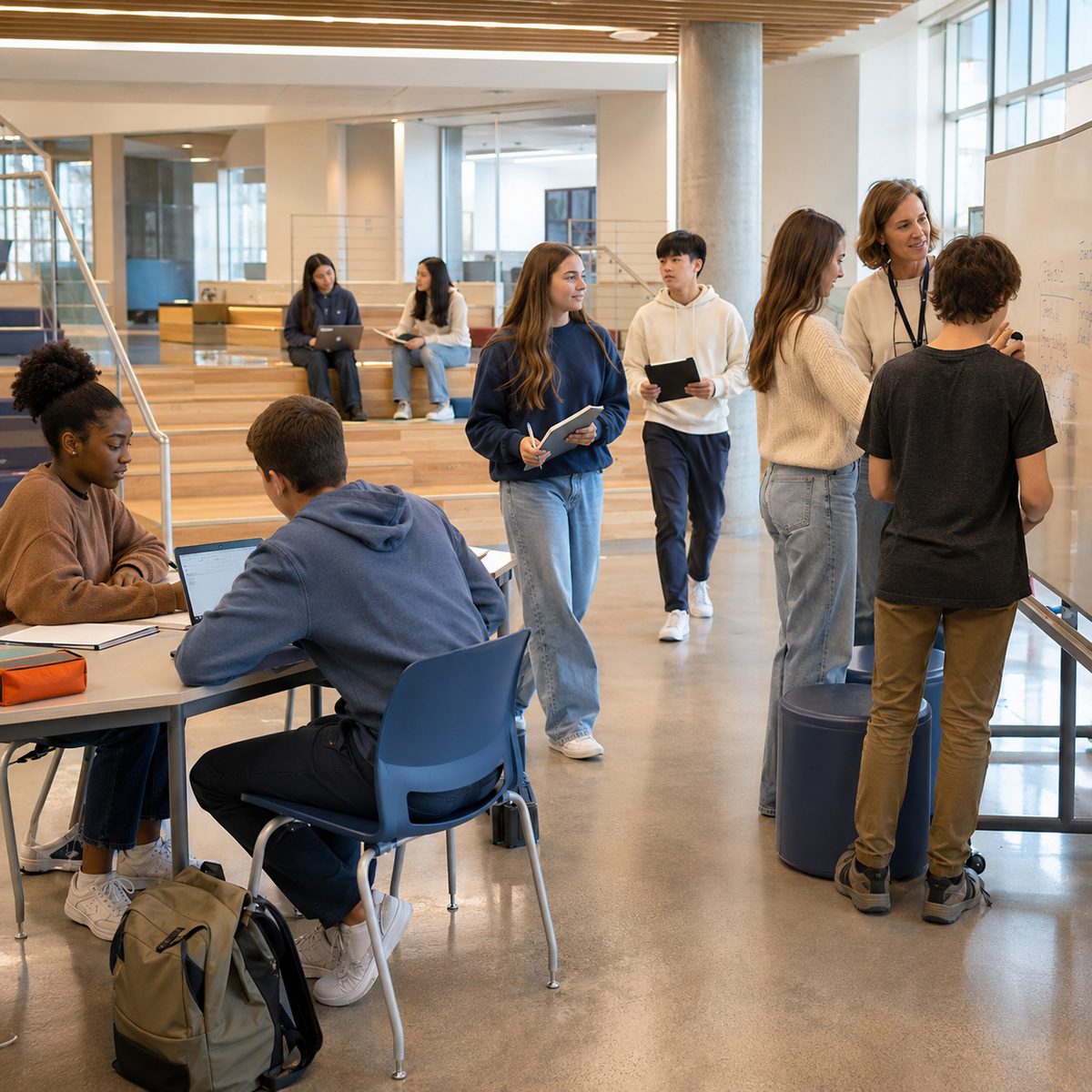
The Superintendent’s Guide to Future-Proofing CTE for Workforce Demand
Career and Technical Education (CTE) programs are growing more popular among school districts. CTE facilities can be a great investment for schools, but only if they continue to reflect workforce needs in the years after they open.
Today’s superintendents face growing expectations from school boards, employers, families, and state agencies to demonstrate that CTE investments produce meaningful outcomes. CTE programs are expected to prepare students for high-demand careers, align programs with local economic priorities, and make responsible long-term investments with limited public resources.
Meeting those expectations requires modern facilities, but it requires a long-term strategy even more.
According to an independent survey of CTE stakeholders, 86% of CTE stakeholders ranked industry-aligned learning environments that engage students as one of the top five factors when selecting a CTE partner. Additionally, 71% measure program success through certification pass rates [1]. These numbers reflect what many superintendents are ultimately accountable for: investments that yield measurable student outcomes.
This guide includes four strategic decisions that can help future-proof your district’s CTE facility.
Decision 1: Choose Career Pathways Based on Where Regional Industry Is Going, Not Where It Has Been
Successful CTE programs are built on one fundamental question:
Where will the jobs be when today’s students graduate?
Career pathway decisions should be driven by current and emerging labor market data rather than historical enrollment patterns or legacy programs.
For example, Industry 4.0 technologies continue to reshape manufacturing by integrating automation, robotics, artificial intelligence, data analytics, and connected systems into production environments. As a result, pathways such as Advanced Manufacturing, Mechatronics, Industrial Maintenance, and Robotics increasingly share foundational technical competencies rather than operating as entirely separate disciplines.
Superintendents who regularly evaluate regional workforce trends are better positioned to build programs that remain relevant as local industries evolve.
Perkins V reinforces this approach by requiring eligible CTE programs to align with high-skill, high-wage, or in-demand occupations identified through the Comprehensive Local Needs Assessment (CLNA) [2]. Meteor Education offers guidance to help districts optimize their Perkins V funding.
Rather than viewing this requirement solely as a compliance obligation, districts can use it as a strategic planning framework that strengthens partnerships with local employers and demonstrates responsiveness to community workforce needs.
Future-proofing begins with selecting career pathways that anticipate tomorrow’s economy.
Decision 2: Build for Credential Quality, Not Credential Volume
The number of students completing a program does not complete the story.
Increasingly, employers are looking for candidates who possess industry-recognized credentials that demonstrate verified technical competencies.
The more meaningful question is “How many students earned credentials that local employers recognize and value?”
Stackable credentials provide an additional advantage because they allow students to build progressively toward higher levels of technical expertise throughout high school and beyond.
The National Coalition of Certification Centers (NC3) works with manufacturing partners to develop nationally recognized, stackable certifications that reflect current industry practices [3]. Because these credentials evolve alongside employer needs, they help districts maintain stronger alignment between instruction and workforce expectations.
Credential quality also provides an accountability metric that school boards, community partners, and families can easily understand.
Decision 3: Treat Equipment as a Program Asset, Not a One-Time Purchase
Superintendents should view equipment as long-term strategic assets rather than one-time capital purchases. Technology evolves rapidly across nearly every technical field. Equipment that is no longer useful current workplace practices can limit students’ exposure to the tools and technologies they are likely to encounter after graduation.
Rather than replacing outdated equipment when it is no longer necessary, it is more strategic and cost effective to establish an equipment lifecycle strategy that anticipates future replacement and modernization needs.
Thinking in terms of total cost of ownership allows districts to make more sustainable long-term investments. A district that plans for equipment refresh cycles avoids budget shock and makes a stronger ongoing case for Perkins V investment.
Programs such as Meteor + ATC’s Trade-In & Trade-Up initiative can help districts modernize equipment over time without requiring complete equipment replacement, supporting continuous improvement rather than periodic overhauls.
Decision 4: Measure Outcomes and Use the Data to Build the Case for What Comes Next
The strongest case for continued investment is evidence.
School boards increasingly expect districts to demonstrate that CTE investments improve student outcomes and advance strategic priorities.
In addition to the 71% of CTE stakeholders who measure program success through certification pass rates, 59% track enrollment growth and participation in work-based learning experiences [1].
These metrics help answer important questions such as:
- Are more students participating in CTE?
- Are students earning meaningful credentials?
- Are programs expanding opportunities for work-based learning?
- Are facilities supporting stronger instructional outcomes?
Outcome data also strengthens future funding requests by providing objective evidence that investments are yielding measurable results.
When planning and measurement work together, districts build stronger cases for continued investment in their education programs.
Future-Proofing Is About More Than Facilities
Future-ready CTE programs are built on strategic decisions rather than short-term projects.
They draw on labor market data, meet industry certification requirements, and treat equipment as an evolving program asset.
Additionally, they continuously measure outcomes to guide future investment.
For superintendents, these decisions shape how districts prepare students for college, careers, and lifelong success while demonstrating responsible stewardship of public resources.
Meteor Education partners with district leaders to think beyond individual facilities by supporting pathway planning, strategic alignment, outcome measurement, equipment lifecycle management, and long-term program success.
When districts plan with the future in mind, they create learning environments that continue delivering value for students, employers, and communities for years to come.
Superintendents can speak to a Meteor Education expert to begin the future-proofing process.
Frequently Asked Questions
Regional industries evolve over time. Reviewing labor market trends helps districts ensure their CTE programs continue preparing students for occupations that are growing locally and nationally.
Industry-recognized credentials provide evidence that students have demonstrated competencies valued by employers. Stackable credentials can also support continued education and career advancement after high school.
Tracking outcomes such as certification pass rates, enrollment growth, work-based learning participation, and employer engagement provides measurable evidence that programs are meeting district goals and supporting workforce development.
Ready to transform your existing space into a dynamic learning hub that engages every student? Contact the K-12 learning environment experts at Meteor Education today to start a conversation and bring your vision to life.
Get in touch
Find Your Local Studio
Meteor Education partners with schools to create collaborative spaces that accelerate engagement and empower educators.