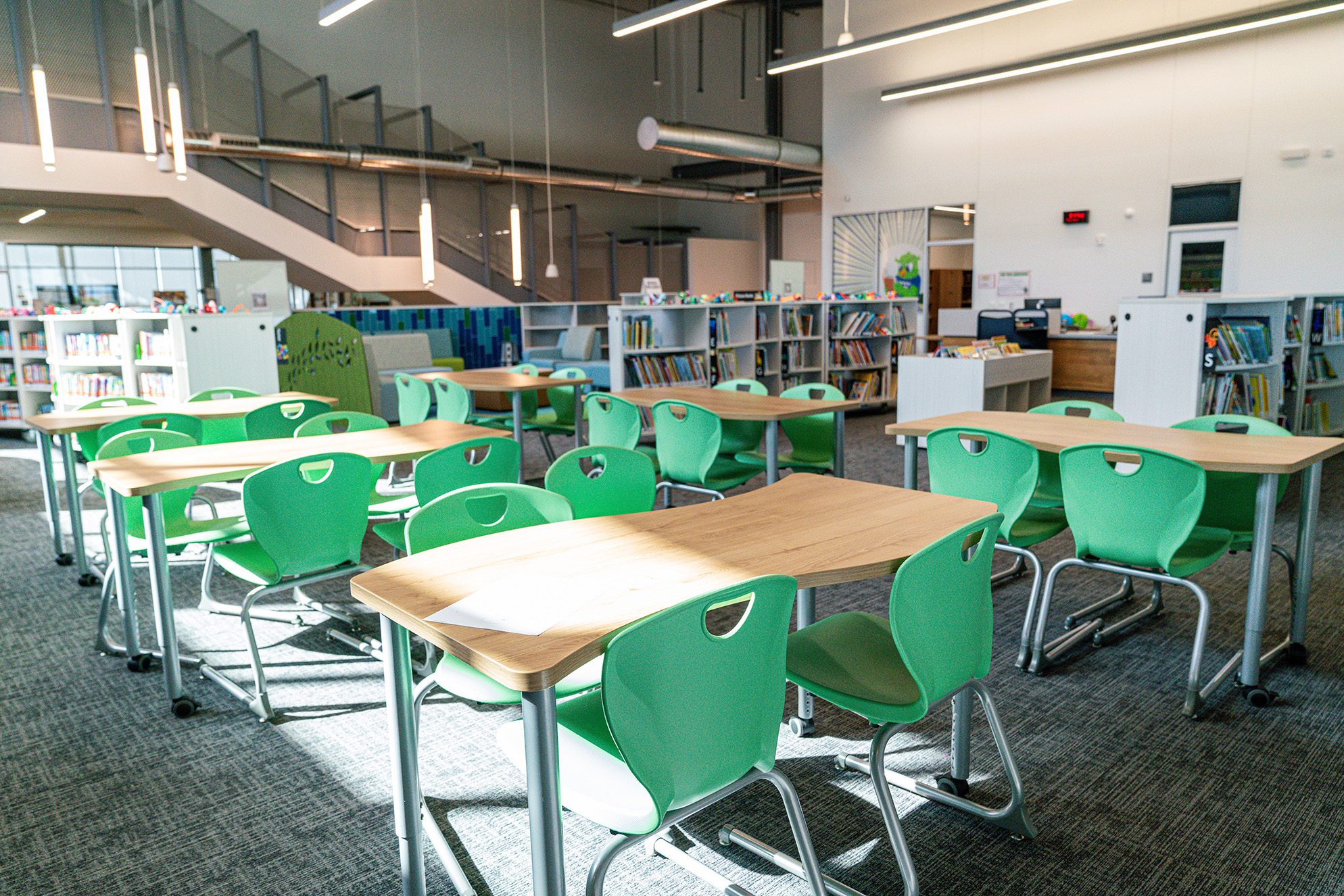
K–12 STEM Lab & Maker Space Design Guide
How to Design a STEM Lab or Maker Space: A K–12 Planning Guide
STEM labs and maker spaces are often the most complex and high-investment environments a school district will build. When aligned to instructional goals, these environments can significantly improve student engagement, collaboration, and career readiness. Without a clear framework, they often go underutilized and feel like wasted investment.
This guide provides a step-by-step planning framework for district leaders, principals, CTE directors, and design partners, combining peer-reviewed research with implementation strategies used in real district projects. Meteor Education is the leader in the design, delivery, and optimization of collaborative, flexible learning environments for K–12 schools. Through a full-service model that includes design, installation, post-install training, and measurement, Meteor helps districts realize their ideal learning spaces.
Step 1: Define the Learning Goals Before Visualizing the Space
Effective STEM environments begin with clearly defined outcomes. Furniture vendors and contractors can jump in quickly, but if the educational goals have not been defined, the result can become a space that reflects aesthetic preferences rather than a clear instructional vision.
Defining measurable outcomes before the design process begins is critical because those outcomes will later inform the Impact Report, a measurement tool that gives districts data they can present to school boards and community stakeholders to justify the investment.
Meteor Education uses a structured facilitation process called the Vision Workshop to align district leadership, teachers, and community stakeholders around learning goals before any spec is written. It is designed to establish priorities, resolve competing stakeholder perspectives, and build defensible design decisions.
| 10 Questions to Ask Before You Design a STEM Lab or Maker Space: |
|---|
| What are the three to five student outcomes this space must support? |
| Which courses, grade levels, and CTE pathways will use it? |
| How will teachers be expected to configure and use the space? |
| What does a successful class period in this space look like? |
| What are the constraints? Budget, timeline, square footage, existing infrastructure? |
| Who are all the stakeholders who need to be aligned before design begins? |
| What existing furniture or equipment can be reused? |
| What does the five-year utilization projection look like? |
| How will you collect data to evaluate the space’s effectiveness? |
| What is the approval and procurement process, and what is the realistic timeline? |
Step 2: Assess the Existing Space
Once learning goals are established, the next step is an honest evaluation of what you are working with physically. Electrical capacity, ventilation, and acoustic properties, for instance, are some of the most common sources of budget surprises and design rework.
Key physical factors to evaluate:
| Factor | Why It Is Important |
|---|---|
| Square footage and ceiling height | Determines what configurations are possible; ceiling height affects equipment clearance and acoustics |
| Electrical load and outlet placement | High-draw equipment (laser cutters, 3D printers, welding stations) requires planning early |
| Ventilation and HVAC | Active fabrication environments generate fumes, heat, and particulates; ventilation affects equipment placement |
| Plumbing | Required for certain CTE pathways (biomedical, culinary, HVAC/R); retrofitting is expensive |
| Natural light and window placement | Affects display visibility, student comfort, and energy use |
| Load-bearing walls and fixed utilities | Constrain renovation options; must be identified before design begins |
| Building codes and ADA compliance | Non-negotiable; affects doorway widths, turning radii, counter heights, and egress |
Not everything in the current space needs to go. An audit of existing assets can significantly reduce project costs. Meteor Education’s Reuse and Recycle program helps identify what can be repurposed, recycled, or redistributed, and its Current Environment Assessment formally documents conditions, assets, and constraints before design begins.
Step 3: Plan for Flexibility and Multiple Modes of Learning
Research on active learning consistently shows that student engagement increases when the environment supports varied instructional modes [1]. STEM labs and maker spaces need to be designed to support all of these modes, even within a single class period.
Furniture principles:
- Movable furniture, writable surfaces, and height-adjustable workbenches are foundational to flexible learning environments
- Fixed lab tables limit flexibility; avoid them unless curriculum demands it (for example, a welding program with fixed exhaust requirements)
- BIFMA-certified furniture meets independently validated standards for safety, durability, and performance. These are important in high-use environments like maker spaces [2]
Zoning:
Define dedicated areas within the same room for different types of activity:
- Fabrication zone: Power tools, 3D printers; higher noise tolerance and ventilation
- Digital creation zone: Computers, tablets, audio/video production; lower noise, better lighting control
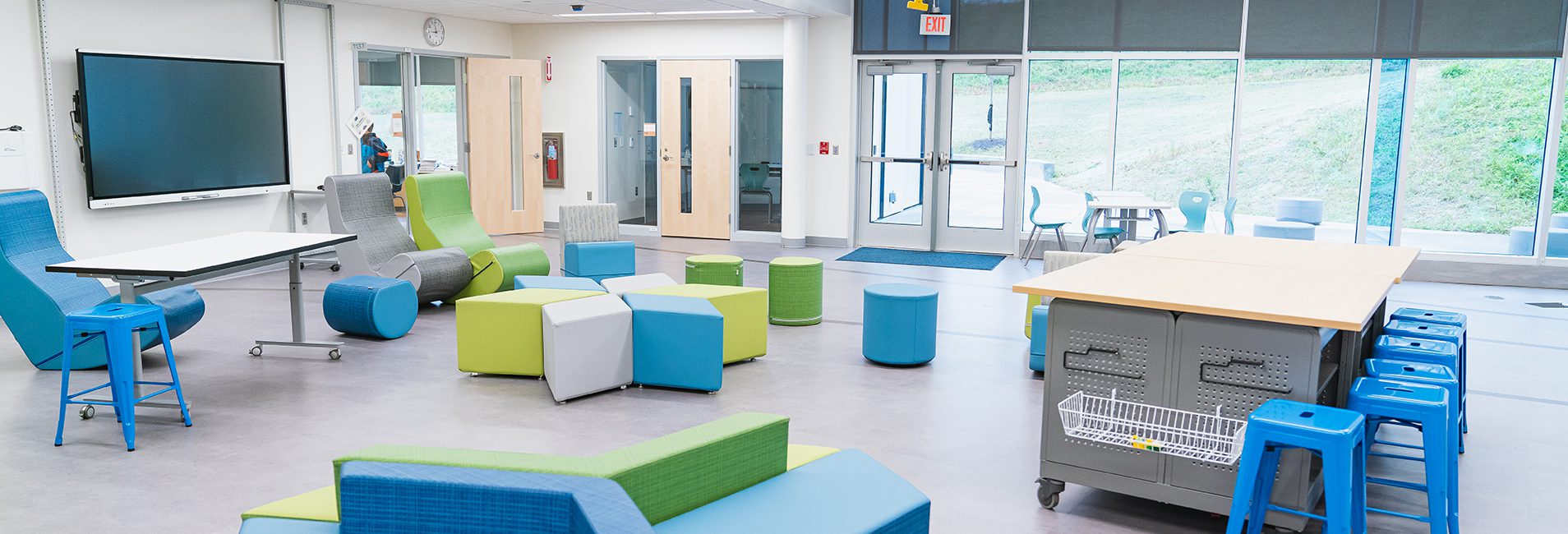
- Ideation zone: Writable surfaces, flexible seating, movable whiteboards; supports brainstorming and project planning
- Presentation zone: Display screen, flexible audience seating; supports student-led sharing and critique
Acoustic planning:
Workshops make a lot of noise. If acoustic zoning is not addressed in the design phase, it will impact instruction in nearby classrooms and within the space itself. Material selection (acoustic ceiling tile, sound-absorbing panels, soft furniture) and physical zoning together can help reduce this problem without major construction.
Meteor’s Collaborative Design Process pairs an interior designer with an educator specifically to address these kinds of intersections between physical design and instructional practice.
Step 4: Select Furniture and Equipment
| Criteria | What to Look For |
|---|---|
| Flexibility | Movable, reconfigurable, stackable or nestable for storage |
| Durability | BIFMA certification; materials appropriate for high-use environments |
| Safety | Rounded edges, stable bases, weight limits appropriate for age group |
| ADA compliance | Accessible heights, clearances, and approach distances |
| Warranty and lifecycle | Quality STEM furniture should last 10+ years; evaluate total cost of ownership, not unit price |
Equipment selection criteria:
- Align every equipment selection to a specific CTE pathway, curriculum unit, or learning outcome
- Equipment that cannot be mapped to a course or certification is difficult to justify to school boards and community stakeholders
- Consult district facilities staff on electrical, ventilation, and safety requirements before finalizing selections
- Confirm OSHA compliance requirements for any power tools, chemical storage, or industrial-grade equipment [3]
Meteor Education’s dedicated CTE equipment catalog means districts can source both classroom furniture and specialized lab equipment through a single engagement. Before any purchase commitment is made, Meteor’s in-house design team can produce photorealistic 3D renderings that show exactly how selected furniture and equipment will look and function in the actual space.
Step 5: Budget Planning
STEM lab and maker space budgets vary based on a combination of factors. The most useful framework is to understand the cost categories and the variables that drive each one.
Primary budget categories:
| Category | Variables That Drive Cost |
|---|---|
| Furniture | Square footage, flexibility requirements, material grade, manufacturer lead times |
| Equipment | CTE pathway alignment, quantity, power and ventilation requirements |
| Installation | Project complexity, union labor requirements, existing infrastructure |
| Design and project management | Scope of Collaborative Design services, number of stakeholders, revision cycles |
| Training | Number of teachers, scope of environment orientation |
| Contingency | Recommended at 15 to 25% for renovation projects [4] |
Total cost of ownership:
Total cost of ownership is key to how school leaders should budget for classroom furniture. Districts that select lower-cost furniture to reduce upfront spend frequently find that they are replacing it within four to six years in high-use environments. Quality STEM furniture often costs less per year than cheaper alternatives that require earlier replacement.
Procurement vehicles:
Meteor Education is available through cooperative purchasing contracts including BuyBoard and TIPS, which allow districts to bypass individual bid processes while staying compliant with public purchasing requirements. Meteor’s proprietary SCOPE budget tool helps districts estimate and plan costs before committing to a full specification.
Step 6: Implementation Timeline and Key Milestones
A complete STEM lab or maker space construction project typically runs six to twelve months, with procurement and manufacturing lead times as the most variable factors. Phases can overlap, and some can be compressed depending on project complexity and purchasing vehicle.
| Phase | Key Activities | Typical Duration | Meteor’s Role |
|---|---|---|---|
| 1. Discovery and goal-setting | Vision Workshop; stakeholder alignment; learning goal definition; design standards | 2 to 4 weeks | Facilitates Vision Workshop; documents outcomes |
| 2. Space assessment | Current Environment Assessment; physical audit; existing asset review | 1 to 2 weeks | Conducts formal Current Environment Assessment |
| 3. Collaborative Design | Space programming; zoning; furniture and equipment specification; 3D renderings | 4 to 8 weeks | Interior designer and educator lead design process |
| 4. Quoting and procurement | RFQ/RFP preparation; cooperative contract processing; board approval | 2 to 6 weeks | Prepares specifications; supports procurement documentation |
| 5. Manufacturing and delivery | Custom furniture production; equipment sourcing and delivery | 6 to 16 weeks | Coordinates with 240+ manufacturer network; tracks lead times |
| 6. Installation | Furniture and equipment installation; in-person project management | 1 to 4 weeks | In-house project managers on-site throughout installation |
| 7. Environment Orientation | Teacher training; configuration walkthroughs; pedagogical integration | 1 to 2 days post-install | Delivers Environment Orientation training |
| 8. Impact measurement | Student engagement data; utilization tracking; teacher feedback collection | 30 to 90 days post-occupancy | Produces formal Impact Report for district stakeholders |
Step 7: Post-Install Training and Measurement
A well-designed STEM lab or maker space is only as effective as the teachers who know how to use it. Without training, teachers default to the familiar: rows, fixed configurations, whole-group instruction. The physical environment stops being an instructional asset.
Environment Orientation:
Meteor’s post-install Environment Orientation ensures that teachers understand how to intentionally configure the space for different instructional modes. This includes:
- Walkthrough of all furniture configurations and their pedagogical applications
- Guided practice with equipment
- Discussion of how to align space configurations to specific lesson types
- Documentation and signage support for ongoing reference
Measuring outcomes:
The most credible STEM and maker space projects define success metrics before the space opens. Valid inputs for outcome measurement include:
- Student engagement metrics (observational or survey-based)
- Space utilization data (periods used per day, student headcount)
- Teacher satisfaction and confidence surveys
- Student performance data tied to CTE pathway outcomes
- Certification pass rates where applicable
Meteor’s Impact Report is a formal post-occupancy measurement document that synthesizes these inputs into a stakeholder-ready report. It gives district leaders the evidence they need to justify the investment to school boards, communicate value to the community, and build the case for future phases of investment.
Choosing a Strategic Partner
STEM labs and maker spaces should not be piecemeal commodity purchases. They are complex, multi-phase projects that require expertise across instructional design, interior design, procurement, project management, and post-install training. A suitable vendor can deliver a pedagogically sound, physically optimized, fully measured learning environment.
Meteor Education is the only partner that brings an expert educator and an interior designer to the same table for every project. It is backed by a network of 240+ manufacturers, in-house project management, post-install Environment Orientation, and proprietary measurement tools including the Current Environment Assessment and Impact Report. From the Vision Workshop through post-occupancy data collection, Meteor is a reliable partner at every phase.
Ready to start planning?
Frequently Asked Questions
STEM labs map to specific coursework and industry certifications, particularly in CTE contexts. They are designed around defined curricula, and the equipment and furniture selections are driven by those pathway requirements. Maker spaces tend to be more exploratory and cross-disciplinary, designed to support student agency, creative problem-solving, and project-based learning across subject areas. Many schools today blend both functions in a single environment, creating a CTE-aligned lab that also includes open maker zones for broader experimental use. The planning process should clarify which model you are building before design work begins.
Cost varies significantly based on square footage, environment type, equipment requirements, and whether structural renovation is involved. Rather than a single number, districts are better served by a cost-per-square-foot and cost-per-student framework built around their specific scope. Meteor’s SCOPE budget tool helps districts develop a defensible cost range early in the planning process, before detailed specification work begins. Cooperative purchasing contracts (BuyBoard, TIPS) can also meaningfully reduce per-unit costs and simplify the procurement process. Contact Meteor Education for an estimate based on your project parameters.
A full-scope project typically runs six to twelve months from initial conversations to occupancy. The most variable phase is manufacturing and delivery, which can range from six to sixteen weeks depending on custom specifications and manufacturer lead times. Districts that begin planning in the spring for a fall installation target are generally well-positioned; those beginning in the fall for the same school year often face timing pressure. The implementation timeline table in Step 6 above provides a detailed phase-by-phase breakdown.
Ready to transform your existing space into a dynamic learning hub that engages every student? Contact the K-12 learning environment experts at Meteor Education today to start a conversation and bring your vision to life.
Sources
Young Architect Academy, “Construction Contingency: Types, Percentages, and How It Works,” March 14, 2025.Top School Furniture Companies in Michigan
Get in touch
Find Your Local Studio
Meteor Education partners with schools to create collaborative spaces that accelerate engagement and empower educators.