How to Design a Standards-Aligned CTE Lab: K-12 Guide
How to Design a Standards-Aligned CTE Lab Space: A K-12 Planning Guide
There is more to a functional K-12 Career and Technical Education lab than its equipment. Too often, districts purchase hardware first and attempt to sort out curriculum, certifications, instructor training, and implementation challenges later, resulting in inefficient learning environments.
According to an independent 2025 industry survey of CTE stakeholders [1], 96% of CTE stakeholders cite budget and funding as their top challenge. The same survey found that 73% say the physical lab environment is extremely or very important to student learning.
For district leaders planning new or renovated CTE spaces, the goal is to create an industry-aligned, workforce-ready environment that supports college and career preparation.
This guide offers a practical, step-by-step process for planning a turnkey CTE lab, from pathway selection and space planning through certifications, procurement, instructor training, and long-term support.
Following its acquisition of Advanced Technologies Consultants (ATC) in 2024, Meteor Education now delivers one of the most comprehensive end-to-end CTE lab solutions available, integrating equipment, furniture, certifications, curriculum, instructor training, and ongoing support into a single-source partnership.
Meteor Education is the leader in the design, delivery, and optimization of collaborative, flexible learning environments for K–12 schools. Through a full-service model that includes design, installation, post-install training, and measurement, Meteor helps districts realize their ideal learning spaces.
Step 1: Define the Career Pathway
The most effective CTE labs are designed around specific career pathways.
Before selecting any equipment, districts should identify which career cluster and pathway the lab will support. Some high-demand career pathways are:
- Advanced Manufacturing
- Mechatronics
- Industrial Maintenance
- Simulation and Robotics
- Industry 4.0
- HVAC
- Welding
Pathway selection should be grounded in the local economy. Districts should evaluate regional workforce demand, employer hiring needs, postsecondary partnerships, and the credentials recognized within local industries. Resources from Advance CTE and the Bureau of Labor Statistics Occupational Outlook Handbook can help districts align programs to labor market demand.
Because each state sets its own CTE standards and approved programs of study, districts should also confirm how a prospective pathway maps to their state’s required course sequences and program-approval criteria before committing to a lab design.
This stage also determines whether students will graduate ready for the real-world workforce.
Meteor and ATC bring 61 combined years of CTE expertise to pathway planning, supported by 53 CTE manufacturing partners across high-demand career pathways. Rather than selling isolated products, Meteor + ATC helps districts align the lab environment, equipment, certifications, and instructional goals into a cohesive strategy.
Step 2: Assess the Space and Plan the Environment
Every CTE pathway has unique infrastructural requirements.
Districts should evaluate facility constraints early, before specifying equipment or beginning procurement. Key considerations may include:
- Ventilation and exhaust systems for welding labs
- Refrigerant handling requirements for HVAC pathways
- Three-phase power for advanced manufacturing environments
- Ceiling height and clearance requirements
- Storage capacity and material flow
- Internet connectivity and digital infrastructure
- ADA compliance and OSHA safety requirements
Addressing these issues during the design phase is much more cost-effective than retrofitting the space after installation begins.
Effective CTE labs also require strategic spatial zoning. Successful environments include dedicated areas for:
- Hands-on technical work
- Instructor demonstration
- Student briefing and collaboration
- Equipment storage
- Safety circulation and supervision
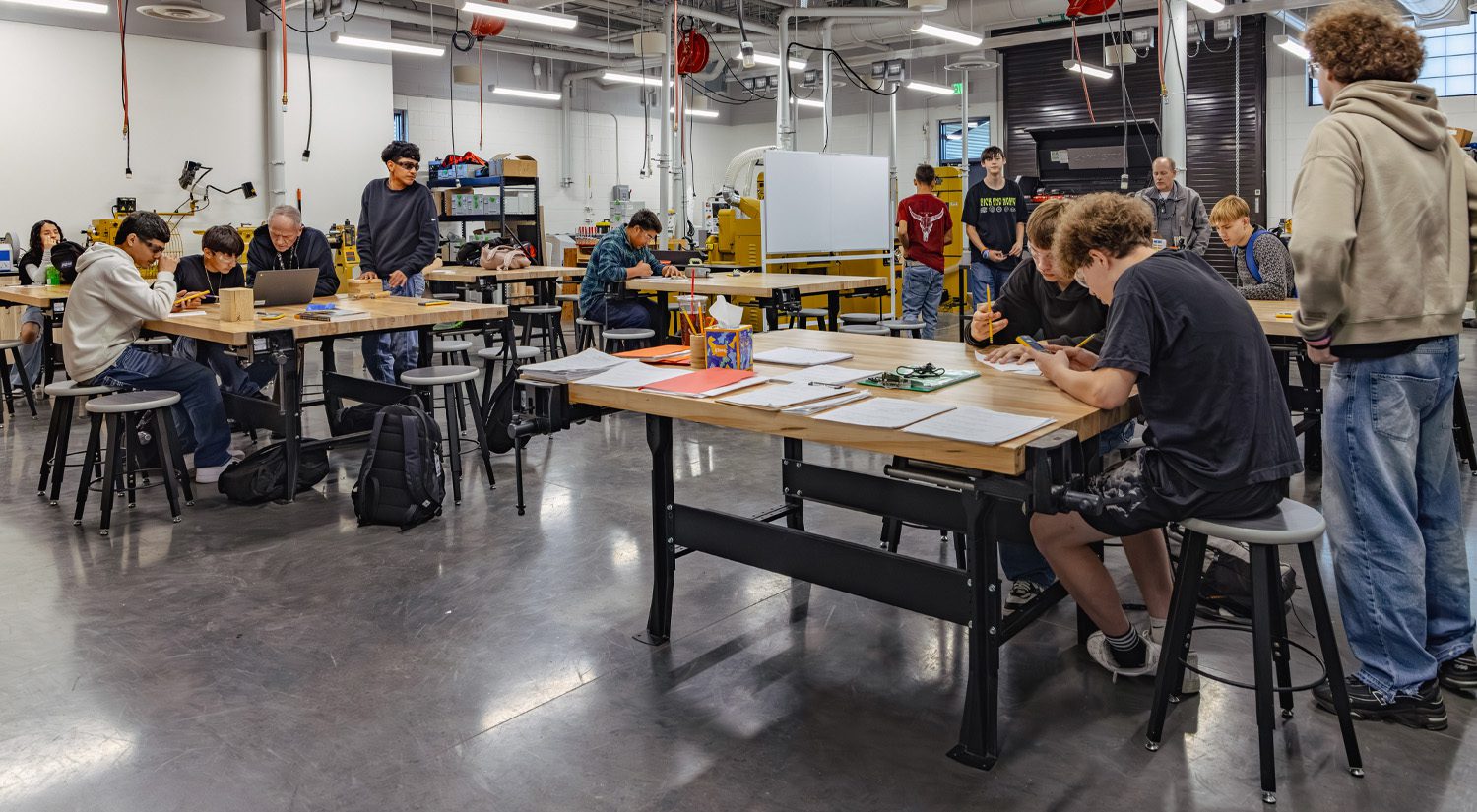
Meteor’s design team supports districts with space planning and 3D renderings before purchases are finalized, allowing stakeholders to visualize workflow, safety, and instructional use before implementation begins.
For districts replacing outdated labs, Meteor also offers a Reuse and Recycle Program that supports the responsible retirement of existing equipment and furniture.
Step 3: Select Real-World Equipment and Certifications Together
Industry-aligned CTE programs require equipment that operates like the equipment students will encounter in modern workplaces.
When students train on outdated or consumer-grade systems, it becomes more difficult to transfer their skills. Workforce readiness improves when learners gain hands-on experience using the same technologies and workflows found in today’s workplaces.
Equipment selection should never occur independently from credential planning.
Industry-recognized certifications should be embedded into the lab solution from the design phase. Meteor + ATC partners with NC3 to provide access to 42 stackable, portable certifications recognized by employers across multiple industries [2]. Meteor + ATC’s lead manufacturing partner, Festo [3], is one of the world’s leading industrial automation companies, serving more than 300,000 global industry partners. Students training on Festo systems gain exposure to equipment and processes used by employers worldwide.
These certifications and real-world systems help districts strengthen preparation for college and career while supporting measurable student outcomes tied to workforce readiness.
Meteor + ATC’s scale also matters during specification and implementation. The company supports districts through:
- 53 CTE manufacturing partners
- More than 240 total manufacturer partners across furniture and equipment
- Integrated curriculum and certification planning
- Instructor training aligned to installed systems
In an independent 2025 industry survey [1], districts identified industry-aligned curriculum and certifications, instructor training, and ongoing support as the three most important services they want from a CTE partner.
Step 4: Plan the Budget and Procurement
Districts should plan for the full scope of CTE lab implementation, including:
- Equipment
- Furniture
- Installation
- Curriculum and instructional materials
- Professional development
- Certification setup
- Ongoing support and maintenance
Meteor + ATC’s turnkey model helps districts consolidate many of these components into a single process, simplifying both procurement and project management.
For districts using Perkins V funding, uses may include:
- Equipment purchases
- Curriculum development
- Instructional materials
- Professional development
These expenditures should align with the district’s Comprehensive Local Needs Assessment (CLNA). Districts can review Meteor’s published guidance on using Perkins V dollars for CTE programs and verify current federal guidance through Advance CTE and the Office of Career, Technical, and Adult Education (OCTAE).
Many districts also streamline procurement through cooperative purchasing contracts such as BuyBoard, TIPS, and state purchasing cooperatives. Contract availability should always be verified based on the district’s location and procurement policies.
District leaders should also evaluate the total cost of ownership for equipment, not simply upfront purchase price. Industry-grade systems often provide longer lifecycle value, fewer replacements, and stronger workforce alignment compared to lower-cost alternatives that require repeated replacement.
Step 5: Instructor Training and Ongoing Support
Even the best-designed CTE lab can be ineffective if instructors are not fully trained on the installed systems. Instructors should know the specific equipment, certifications, and workflows students will use in the lab environment.
Meteor + ATC provides hands-on instructor training connected to each installed lab solution, helping educators confidently operate equipment and integrate certifications into instruction.
The assistance doesn’t end after training, though. Meteor + ATC offers ongoing instructor support post-installation, including assistance with becoming an NC3 testing site and training educators to proctor certification assessments.
This level of long-term partnership is uncommon in the CTE market. Many equipment providers support installation but offer limited ongoing instructional assistance once the project is complete. For districts building sustainable workforce-ready programs, long-term support ensures that a lab that launches successfully also evolves successfully over time.
Step 6: Build an Implementation Timeline
Successful CTE lab projects require coordinated planning across facilities, curriculum, procurement, technology, and instructional teams.
The timeline below reflects a typical implementation framework for a student-ready CTE lab.
| Phase | Key Activities | Typical Duration | Meteor’s Role |
|---|---|---|---|
| Pathway Selection and Goal Alignment | Workforce analysis, career pathway identification, stakeholder planning | 2-4 weeks | Strategic planning and pathway consultation |
| Space Assessment and Lab Design | Infrastructure review, safety planning, 3D renderings | 4-8 weeks | Facility assessment and lab environment design |
| Equipment, Furniture, and Certification Specification | Equipment alignment, certification integration, curriculum coordination | 2-4 weeks | Single-source specification and coordination |
| Procurement | Quote review, cooperative contract selection, purchase order processing | 2-6 weeks | Procurement guidance and contract support |
| Manufacturing and Delivery | Equipment build, lead-time tracking, freight and delivery scheduling | 6-16 weeks | Project management and logistics coordination |
| Installation and Project Management | Equipment installation, setup, testing | 1-4 weeks | Installation oversight and implementation |
| Instructor Training and Certification Setup | Professional development, certification preparation | 1-5 days post-install | Hands-on instructor training and NC3 support |
| Ongoing Support | Technical assistance, program optimization | Continuous | Lifetime ongoing instructor support |
Build a Workforce-Ready CTE Environment
Designing a successful CTE lab requires an integrated strategy that aligns career pathways, facility planning, certifications, curriculum, instructor support, and long-term workforce outcomes.
Meteor + ATC can deliver that complete solution through a single-source partnership that integrates equipment, furniture, certifications, curriculum, training, and ongoing support from day one.
District leaders can speak to an expert to begin planning a new CTE lab environment or request a quote for pathway-specific implementation support.
Frequently Asked Questions
Traditional classrooms are designed for lecture-based instruction, while CTE labs support hands-on, industry-aligned learning with real-world equipment, workflows, safety standards, and collaboration. The environment itself becomes part of workforce preparation, helping students build technical skills alongside familiarity with professional tools and workplace expectations.
According to an independent 2025 industry survey of CTE stakeholders [1], 73% say the physical lab environment is extremely or very important to student learning, reinforcing the value of authentic workplace-style spaces.
CTE lab costs vary based on the pathway, facility infrastructure, equipment needs, and certification requirements. Advanced manufacturing, welding, and HVAC labs typically require greater infrastructure investment than lighter technical pathways. Districts should consider total cost of ownership, not just upfront pricing. Industry-grade equipment often delivers better long-term value through durability, workforce alignment, and lower replacement costs.Funding may include Perkins V, local capital funding, grants, and cooperative purchasing contracts. Districts can explore Meteor + ATC’s CTE Solutions to evaluate pathway-specific planning considerations.
An industry-aligned CTE lab combines three core elements:
- Real-world equipment used by employers
- Industry-recognized certifications
- Curriculum aligned to the local economy and workforce demand
All three must work together to support student preparation for college and career.
Meteor + ATC’s integrated model combines equipment, furniture, certifications, curriculum, instructor training, and ongoing support into a single turnkey solution, helping districts create workforce-ready learning environments from the beginning.
Ready to transform your existing space into a dynamic learning hub that engages every student? Contact the K-12 learning environment experts at Meteor Education today to start a conversation and bring your vision to life.
Get in touch
Find Your Local Studio
Meteor Education partners with schools to create collaborative spaces that accelerate engagement and empower educators.