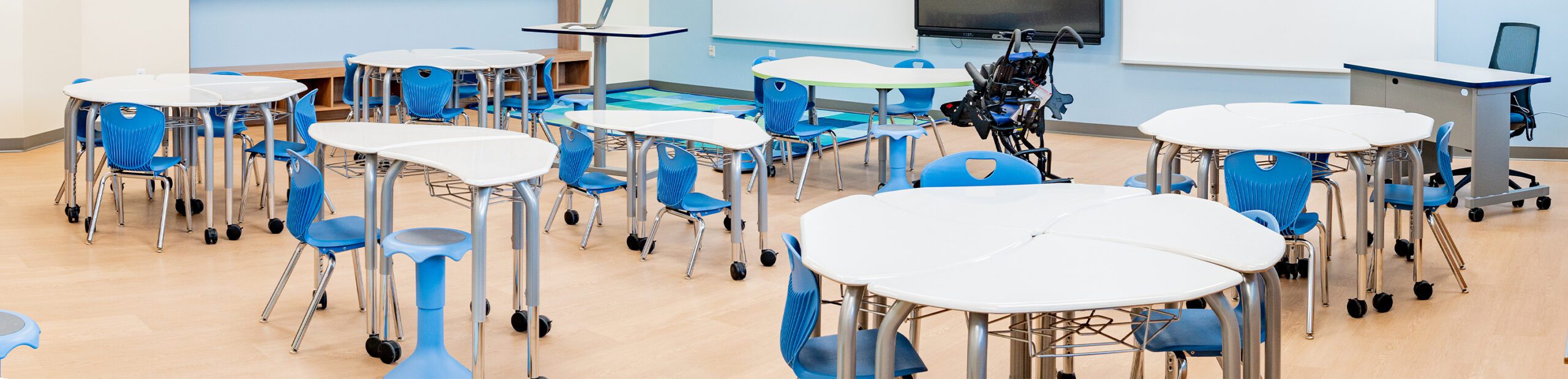
What to Expect From a Turnkey K-12 Furniture Partner
“Turnkey” has become a common buzzword in K-12 furniture procurement, yet it often has a different definition depending on the furniture provider.
Service scope varies significantly among furniture providers, so districts should confirm whether planning, educator support, and post-project follow-up are included in the engagement.
According to a 2025 independent CTE industry survey, 73% of CTE stakeholders say the physical learning environment is extremely or very important to student learning, while 86% rank industry-aligned spaces that engage students among the top five criteria when selecting a partner [1]. Those findings suggest that districts are looking for partners who can help create learning environments that improve student outcomes.
So what does a true turnkey engagement actually include?
This guide outlines the six stages every district should expect from a comprehensive K-12 furniture partner, along with key procurement questions that can help distinguish between a basic furniture procurement engagement and a more comprehensive partnership.
Stage 1: Needs Assessment and Current Environment Review
Effective project partners understand the environment that already exists. APPA, an authority in educational facilities, emphasizes that facility assessments provide critical information for long-term planning, capital investment decisions, and space optimization [2].
Before recommending furniture or developing layouts, a partner should evaluate:
- How learning spaces are currently being used
- Areas that are underperforming
- Furniture that can be reused or repurposed
- Opportunities to improve instructional flexibility
Beginning with Meteor Education’s structured Current Environment Assessment can help ensure recommendations are based on actual district needs rather than assumptions.
Districts should also ask how existing furniture will be managed during the transition. Programs such as Meteor’s Reuse and Recycling can help maximize value from existing assets while reducing unnecessary waste.
Procurement question to ask:
Do you conduct a formal assessment of our current learning environment before proposing a solution?
Stage 2: Collaborative Space Design
Furniture alone does not create effective learning environments.
Effective learning environments factor in more than furniture. Understanding instructional best practices is also essential for success.
A turnkey partner brings together expertise in educational programming and interior design so that furniture is compatible with how teachers teach and how students learn.
When educators participate in the planning process alongside designers, they are more likely to create environments that support collaboration, flexibility, accessibility, and long-term instructional goals.
Meteor’s Collaborative Design process combines educational expertise with professional design to ensure learning environments support both pedagogy and functionality.
Procurement question to ask:
Does your team include educators who participate in the design process, or only designers and sales representatives?
Stage 3: 3D Visualization Before Purchase
One of the greatest advantages of modern planning technology is its ability to help identify potential issues before implementation begins.
Three-dimensional renderings allow district leaders to visualize:
- Furniture placement
- Student and teacher movement
- Accessibility
- Collaboration areas
- Traffic flow
- Space utilization
Seeing a model of a completed facility before placing an order reduces uncertainty and can simplify stakeholder discussions, including presentations to school boards and facilities committees.
As part of its full service, Meteor’s in-house design team produces 3D renderings of the fully furnished facility before any purchasing decision is finalized.
Procurement question to ask:
Is 3D visualization included as part of your engagement, or is it an additional service?
Stage 4: Project Management Through Installation
Project management involves more than furniture delivery. Comprehensive installation includes:
- Coordinating schedules with district facilities staff
- Managing assembly
- Verifying furniture placement
- Confirming the completed space matches approved designs
- Resolving installation issues before project closeout
Strong project management minimizes disruption to teaching and learning so students can stay on schedule while their facilities are improved.
Procurement question to ask:
Will a project manager oversee installation on-site, or is installation handled separately after delivery?
Stage 5: Teacher Training and Environment Orientation
Even if a learning environment is thoughtfully designed, it also needs to be thoughtfully implemented to best serve students.
Without guidance for instructors, flexible classrooms can gradually return to traditional layouts that do not fully leverage the capabilities of the new environment. Instructors need to understand how to best utilize the spaces designed for them.
Meteor’s Environment Orientation helps teachers understand how to:
- Configure flexible furniture
- Support different instructional models
- Adapt spaces for changing classroom needs
Professional training can help districts realize the full value of their investment long after installation is complete.
Procurement question to ask:
Do you provide teacher training after installation, and is it included in the engagement?
Stage 6: Post-Install Measurement
Partners that offer post-installation evaluation can help districts assess whether a new learning environment is meeting its intended goals.
District leaders increasingly seek measurable evidence that facility investments improve outcomes such as:
- Student engagement
- Space utilization
- Instructional flexibility
- Teacher satisfaction
- Collaboration
Meteor’s Impact Report provides districts with structured post-occupancy evaluation data that can inform future planning and helps demonstrate return on investment to school boards and stakeholders.
Procurement question to ask:
Do you have a formal process for measuring whether the learning environment is achieving its intended outcomes after installation?
What Cooperative Purchasing Changes, and What It Does Not
Cooperative purchasing contracts can simplify procurement and help districts streamline purchasing processes. However, cooperative purchasing does not standardize the level of service provided by participating vendors.
The scope of services can vary between providers on the same cooperative contract. Districts should evaluate each partner’s planning process, installation support, educator engagement, and post-project services to ensure they align with the district’s needs.
Regardless of purchasing vehicle, districts should still evaluate the complete engagement model using the questions outlined below.
Procurement Checklist: Six Questions Every District Should Ask
When evaluating furniture partners, consider asking the following questions during your RFP process or vendor interviews:
☐ Do you conduct a formal assessment of our current environment before recommending solutions?
☐ Does your design team include educators as well as professional designers?
☐ Are 3D renderings included before purchase?
☐ Will a dedicated project manager oversee installation?
☐ Is teacher training included after installation?
☐ Do you provide a formal post-occupancy evaluation process?
Building Learning Environments Is More Than Buying Furniture
Furniture purchase decisions influence how students learn, how teachers teach, and how districts use valuable educational space for years to come.
That is why the most successful projects begin with comprehensive planning and continue well after installation is complete.
Meteor Education’s approach combines Current Environment Assessments, Collaborative Design, 3D visualization, project management, Environment Orientation, and Impact Report measurement into a complete engagement that supports districts throughout the life of a project. District leaders can speak with a Meteor Education expert to explore a project partnership.
Frequently Asked Questions
For districts seeking a very comprehensive turnkey engagement, the scope may include planning, design, visualization, project management, educator support, and post-install evaluation
Educators understand how learning environments function on a daily basis. Their input helps ensure spaces support instructional practices rather than simply accommodating furniture.
Yes. Measuring how spaces perform after occupancy helps districts understand whether learning environments are meeting instructional goals and provides valuable information for future investments.
Ready to transform your existing space into a dynamic learning hub that engages every student? Contact the K-12 learning environment experts at Meteor Education today to start a conversation and bring your vision to life.
Sources:
[1] Independent 2025 CTE industry survey
Get in touch
Find Your Local Studio
Meteor Education partners with schools to create collaborative spaces that accelerate engagement and empower educators.