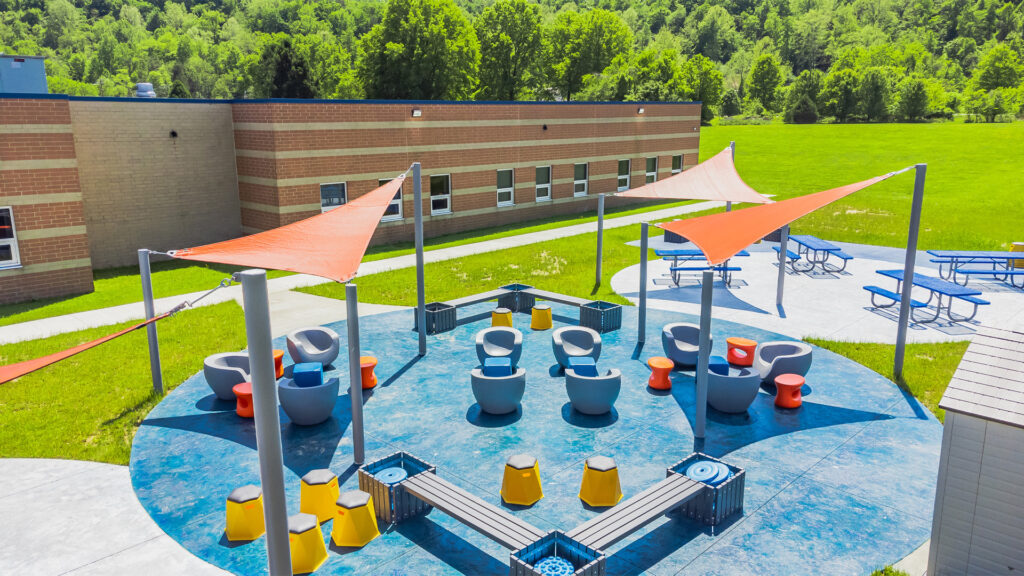
The Classroom Outside: Creative Outdoor Spaces for Modern Learning
I spent much of my teaching career trapped in windowless classrooms, surrounded by four stark concrete walls, before stepping into a principal’s office flooded with natural light from two full walls of windows. Although those windows were sweltering during my first two weeks as principal—before the air conditioning system was updated—I quickly came to value the opportunity to engage with the outdoors. Even now, in my current workspaces, I find myself drawn to natural light, often choosing to work near a window or on a porch when possible.
Over the years, working with schools both in the U.S. and abroad, I have observed a wide spectrum of approaches to outdoor spaces. Some older courtyards have been neglected, reduced to overgrown bushes and brambles, while others have been transformed into vibrant environments with stations for collaboration and experiential learning. In many newly constructed schools, large courtyards safely surrounded by interior classrooms are intentionally designed to support outdoor learning, often featuring expansive windows that visually connect indoor and outdoor spaces. During visits to schools in England, I observed that outdoor spaces were frequently organized into designated zones for different types of learning, both in rural and urban settings. Across Europe, outdoor learning appears to be more widely embraced than in the United States. For example, despite its cold climate, Finland has incorporated outdoor learning into the Finnish National Core Curriculum for Early Childhood Education and Care (Finnish National Board of Education, 2022).
Benefits of Outdoor Learning
The benefits of outdoor learning are well-documented. Exposure to natural environments can have a calming effect on individuals and promote restoration in educational settings, helping students and staff recover emotionally, regain focus, and rebuild relationships (Simkin, Ojala, & Tyrväinen, 2020; Kuo, Barnes, & Jordan, 2019; Chawla, Keena, Pevec, & Stanley, 2014). Outdoor spaces have also been shown to enhance self-confidence and efficacy in adolescents (Fuller, Powell, & Fox, 2017). A comprehensive review by Kiviranta, Lindfors, Rönkkö, and Luukka (2023) highlighted numerous positive outcomes of outdoor learning, including social and personal development, increased leadership skills, enhanced social competence, and opportunities for diverse, creative, hands-on learning experiences. Outdoor learning was also found to promote physical activity, joy, and overall satisfaction, as students engage with and are calmed by natural environments. While outdoor activities have been shown to enhance students’ critical thinking, problem-solving, and collaboration skills, these experiences also produce significant benefits for students with cognitive, emotional, and behavioral disabilities (Szczytko, Carrier, & McGowan, 2018).
Practical Ideas for Schools
Taken together, this research demonstrates that outdoor learning supports not only academic growth but also social-emotional development, physical activity, and inclusive participation for students with diverse needs. Schools can leverage these insights to design outdoor spaces that extend classroom instruction, encourage collaboration, and foster student agency through hands-on, choice-driven experiences. Outdoor spaces provide opportunities for students to collaborate on projects and apply classroom learning on a larger scale. In traditional classrooms, moving large desks and equipment can be challenging, limiting opportunities for active learning. Research supports the importance of student movement, showing positive effects on academic intrinsic motivation, perceived competence, and effort (Vazou, Gavrilou, Mamalaki, Papanastasiou, & Sioumala, 2012). Outdoor learning provides an element of novelty in enhancing learning experiences, which has also been shown to positively impact student learning (Lorents, Ruitenberg, & Schomaker, 2023). With student absentee rates high across all demographic groups (California Department of Education, 2022), outdoor learning can introduce novel, engaging experiences that stimulate the brain and promote active participation.
The following is a list of a few ideas on ways educators can incorporate outdoor learning into their current curriculum.
- Conduct gallery walks where students read posted information, discuss application questions in small groups, and record their responses on clipboards.
- Solve math problems using sidewalk chalk, then evaluate other groups’ work to verify accuracy and offer feedback.
- Search for hidden analytical questions in a small group scavenger hunt and record answers on clipboards.
- Read books or informational texts silently on benches or blankets outdoors, then reflect through a brief writing or pair discussion.
- Discuss literature or informational texts in small groups at outdoor picnic tables, emphasizing evidence-based dialogue.
- Create a large historical timeline using chalk or rope to illustrate key events and make connections between them.
Outdoor spaces also provide new ways to accelerate student engagement by broadening classroom instruction and fostering student agency, allowing learners to pursue hands-on, self-directed experiences that deepen understanding. The California Department of Education highlights numerous ways schools can leverage outdoor learning areas—from school and community garden projects to campus improvements and local ecosystem support (California Department of Education, 2025).
The following is a list of a few ideas on ways educators can incorporate outdoor learning into their current curriculum, from gallery walks to outdoor discussions and hands-on projects.
Outdoor Learning Opportunities
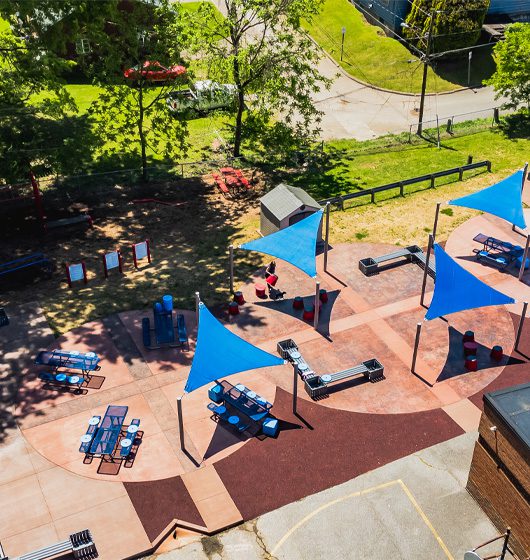
Explore practical ways to transform school grounds into engaging, hands-on learning environments
- Repaint outdoor structures (e.g., fences, benches, playground equipment)
- Create murals reflecting school culture, community history, or student artwork
- Design and build outdoor benches, shade structures, or collaborative learning stations
- Plant native species to support pollinators
- Monitor air quality, track migratory birds, test water samples, or catalog biodiversity
- Install birdhouses, bat boxes, or insect hotels
- Build rain gardens to manage stormwater and promote water conservation
- Plant trees or shrubs to provide shade and improve air quality
- Design, plant, and maintain vegetable gardens, and then donate produce to local food banks or use it in the school cafeteria
- Create sensory gardens that emphasize texture, fragrance, and color
- Build outdoor compost bins or recycling hubs to teach soil enrichment and waste reduction
- Track and display waste-reduction data on outdoor bulletin boards
- Upcycle outdoor furniture, playground equipment, or art installations
- Develop outdoor exhibits or signage to teach history, science, or art
- Host outdoor environmental fairs or “green expos” to showcase student projects
- Add wayfinding signs, maps, or garden labels designed by students
- Collect and analyze water runoff data before and after rain garden installation
- Integrate math and art by designing geometric garden layouts or murals
- Develop short documentaries or podcasts about school environmental projects
Planning and Designing Outdoor Learning Spaces
Before designing a rich outdoor learning environment, consider several guiding principles: purpose and vision, layout and functionality, and aesthetics. Collaborating with experienced designers can help schools maximize the potential of the space while achieving optimal results. The following questions can serve as a guide during the planning process:
Purpose & Vision
- Who are the primary users (e.g., specific grade levels, after-school programs, or community groups)?
- What learning goals will this outdoor space support (e.g., STEM activities, art projects, social-emotional learning, or physical activity)?
- How will the space complement existing indoor classrooms?
Layout & Functionality
- How can the space be divided into zones to maximize use (e.g., large-group learning areas, small-group zones, and quiet nooks)?
- What types of surfaces and furniture are needed for these zones (e.g., benches, tables, amphitheater seating, or whiteboards)?
- How can the space be flexibly designed so that furniture can be moved or adapted for different learning goals?
- What safety considerations need to be addressed?
Aesthetics & Comfort
- What sensory elements will make the space inviting (e.g., colors, textures, or sounds)?
- Where will shade structures, pergolas, or canopies be placed to enhance comfort?
- How can artwork, murals, or student projects personalize the area and make it feel welcoming?
For additional planning ideas, see the Outdoor Learning Environment Guide (Los Angeles County Office of Education, n.d.).
Innovative Outdoor Learning Spaces
Several projects have demonstrated innovative approaches to outdoor learning design, integrating elements such as flexible courtyards, rooftop play zones, and garden-based classrooms. These designs not only expand instructional possibilities but also promote social-emotional development, environmental awareness, and a stronger connection between learners and their surroundings.
Legacy Elementary
Recently, I assisted with the opening of Legacy Elementary in Uvalde, Texas. Following the tragic school shooting in 2022, this new school was designed and constructed with safety, remembrance, and healing at its core. From the project’s inception, safety and security were paramount considerations. When adult and student stakeholders were asked to envision the new school, an overwhelming number of their sketches and diagrams prominently featured outdoor spaces—places of light, openness, and connection to nature. These features are central to all campuses in the school district.
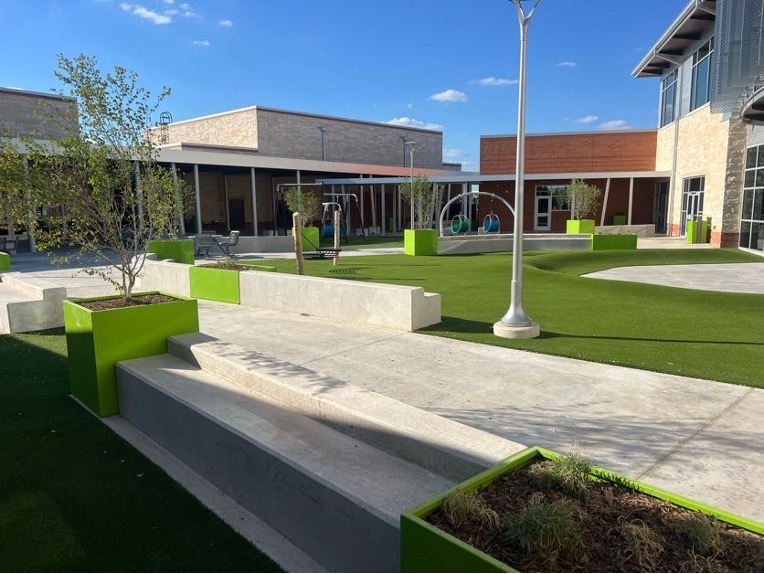
Legacy Elementary was thoughtfully designed with the building forming a secure perimeter, integrating multiple visible and discreet safety features. In the middle of the campus lies a carefully planned courtyard that serves as a central feature of the school. As students travel to lunch, physical education, the playground, or other learning areas, they circulate through and around this space. Guided by trauma-informed design principles, architects recognized that connecting children with nature can lower stress levels, support emotional regulation, and improve executive functioning.The school’s librarian recently shared her desire to have students check out books and move outdoors to read in a variety of seating areas, fostering calm and connection. The courtyard also offers opportunities for modified recess, allowing students to release energy in a secure environment. Teachers can utilize the space for small- or large-group instruction, learning stations, or creative exploration using outdoor chalkboards. Located adjacent to the cafeteria, the courtyard also provides a welcoming setting for counselors to host “lunch bunch” sessions and social-emotional learning activities. The combination of turf and paved surfaces minimizes maintenance while maximizing flexibility and usability.
South Melbourne Primary School
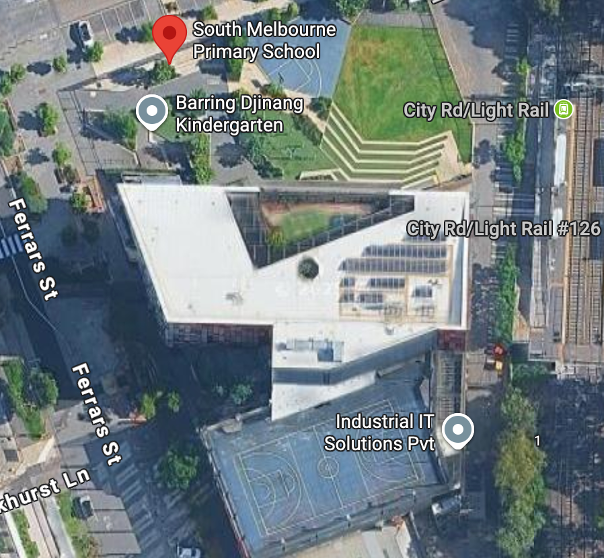
While collaborating with architect Kerri Brady on Legacy Elementary, she mentioned another remarkable project that creatively incorporates student-centered outdoor spaces into its design. Traditionally, courtyards are located at ground level, but innovative urban schools have adapted this concept vertically to maximize outdoor learning and play within limited footprints. South Melbourne Primary School in Australia exemplifies this approach as a six-story “vertical school” on a compact urban site. The facility features multi-level learning terraces that connect directly to classrooms, rooftop sports courts, and a vertical “Treehouse” play structures, enabling active play across several floors. By layering outdoor spaces, the school provides students with rich, engaging, and restorative learning and recreational experiences despite its constrained footprint.
At ground level, the school includes a fenceless civic plaza with stepped terraces, lawns, seating, and water-sensitive landscaping that fosters connection with the surrounding community. Additional outdoor zones offer hard courts for sports, raised garden beds, amphitheater-style seating, and areas for passive socializing. Together, these thoughtfully designed spaces integrate play, learning, and community engagement, illustrating how vertical design can transform outdoor experiences in dense urban environments (Association for Learning Environments, 2018).
This Google satellite image highlights the front lawn and the rooftop court (Google, 2025). The triangular area on top of the building serves as the outdoor play space for early childhood students. For published photographs, refer to the Association for Learning Environments citation.
Outdoor learning spaces provide schools with opportunities to extend classroom instruction while fostering student engagement, creativity, and collaboration. Thoughtfully designed environments—such as gardens, courtyards, and outdoor classrooms—allow students to participate in hands-on, choice-driven experiences that support academic, social-emotional, and physical development. These spaces offer novel and stimulating experiences that increase motivation, encourage movement, and promote self-directed learning. By planning with purpose, flexible layouts, and inviting aesthetics in mind, schools can create outdoor environments that inspire students, strengthen community connections, and expand learning beyond traditional classroom walls. So step outside—and start planning!
Rebecca Stobaugh, Ph.D.
Dr. Rebecca Stobaugh is a Learning Experience Strategist for Meteor Education, where she partners with schools to design innovative learning environments that foster student agency and engagement. A former middle and high school teacher, professor, and instructional coach, she brings deep classroom and leadership experience to her work with districts nationwide. Rebecca has authored multiple books on critical thinking and instructional design, and she is passionate about helping educators create future-ready learning experiences that prepare students to thrive in a complex world.
Email: Beckie.stobaugh@icloud.com
Association for Learning Environments. (2018). South Melbourne Primary School.https://awards.a4le.org/2018/pdf/SouthMelbournePrimarySchool.pdf
California Department of Education. (2022). State of California: Academic engagement. California School Dashboard. Retrieved September 18, 2025, from https://www.caschooldashboard.org/reports/ca/2022/academic-engagement
California Department of Education. (2025, June 26). Outdoor learning environments.https://www.cde.ca.gov/ls/fa/outdoorlearningenviron.asp
Chawla, L., Keena, K., Pevec, I., & Stanley, E. (2014). Green schoolyards as havens from stress and resources for resilience in childhood and adolescence. Health & Place, 28, 1–13. https://doi.org/10.1016/j.healthplace.2014.03.001
Finnish National Board of Education. (2022). National core curriculum for early childhood education and care 2022. Finnish National Board of Education.
Fuller, C., Powell, D., & Fox, S. (2017). Making gains: The impact of outdoor residential experiences on students’ examination grades and self-efficacy. Educational Review, 69(2), 232–247.https://doi.org/10.1080/00131911.2016.1199538
Google. (2025). Satellite view of South Melbourne Primary School [Map]. Google Maps.https://www.google.com/maps/place/South+Melbourne+Primary+School/@-37.8291597,144.9509782,751m/data=!3m2!1e3!4b1!4m6!3m5!1s0x6ad667f88d4f17e5:0x605f928cdb450a54!8m2!3d-37.829164!4d144.9535531!16s%2Fg%2F11fxbj6jk_?entry=ttu&g_ep=EgoyMDI1MTAyNi4wIKXMDSoASAFQAw%3D%3D
Kiviranta, L., Lindfors, E., Rönkkö, M. L., & Luukka, E. (2023). Outdoor learning in early childhood education: Exploring benefits and challenges. Educational Research, 66(1), 102–119.https://doi.org/10.1080/00131881.2023.2285762
Kuo, M., Barnes, M., & Jordan, C. (2019). Do experiences with nature promote learning? Converging evidence of a cause-and-effect relationship. Frontiers in Psychology, 10, 305. https://doi.org/10.3389/fpsyg.2019.00305
Los Angeles County Office of Education. (n.d.). Outdoor learning environment guide.https://acrobat.adobe.com/id/urn:aaid:sc:US:312ad24c-f0e0-48c9-a9c7-ede4d3ae331d
Lorents, A., Ruitenberg, M. F. L., & Schomaker, J. (2023). Novelty-induced memory boosts in humans: The when and how. Heliyon, 9(3), e14410. https://doi.org/10.1016/j.heliyon.2023.e14410
Simkin, J., Ojala, A., & Tyrväinen, L. (2020). Restorative effects of mature and young commercial forests, pristine old-growth forest, and urban recreation forest: A field experiment. Urban Forestry & Urban Greening, 48, 126567.https://doi.org/10.1016/j.ufug.2019.126567
Szczytko, R., Carrier, S. J., & McGowan, J. (2018). Impacts of outdoor environmental education on teacher reports of attention, behavior, and learning outcomes for students with emotional, cognitive, and behavioral disabilities. Frontiers in Education, 3, Article 46. https://doi.org/10.3389/feduc.2018.00046
Vazou, S., Gavrilou, P., Mamalaki, E., Papanastasiou, A., & Sioumala, N. (2012). Does integrating physical activity in the elementary school classroom influence academic motivation? International Journal of Sport and Exercise Psychology, 10(4), 251–263. https://doi.org/10.1080/1612197X.2012.682368
Get in touch
Find Your Local Studio
Meteor Education partners with schools to create collaborative spaces that accelerate engagement and empower educators.