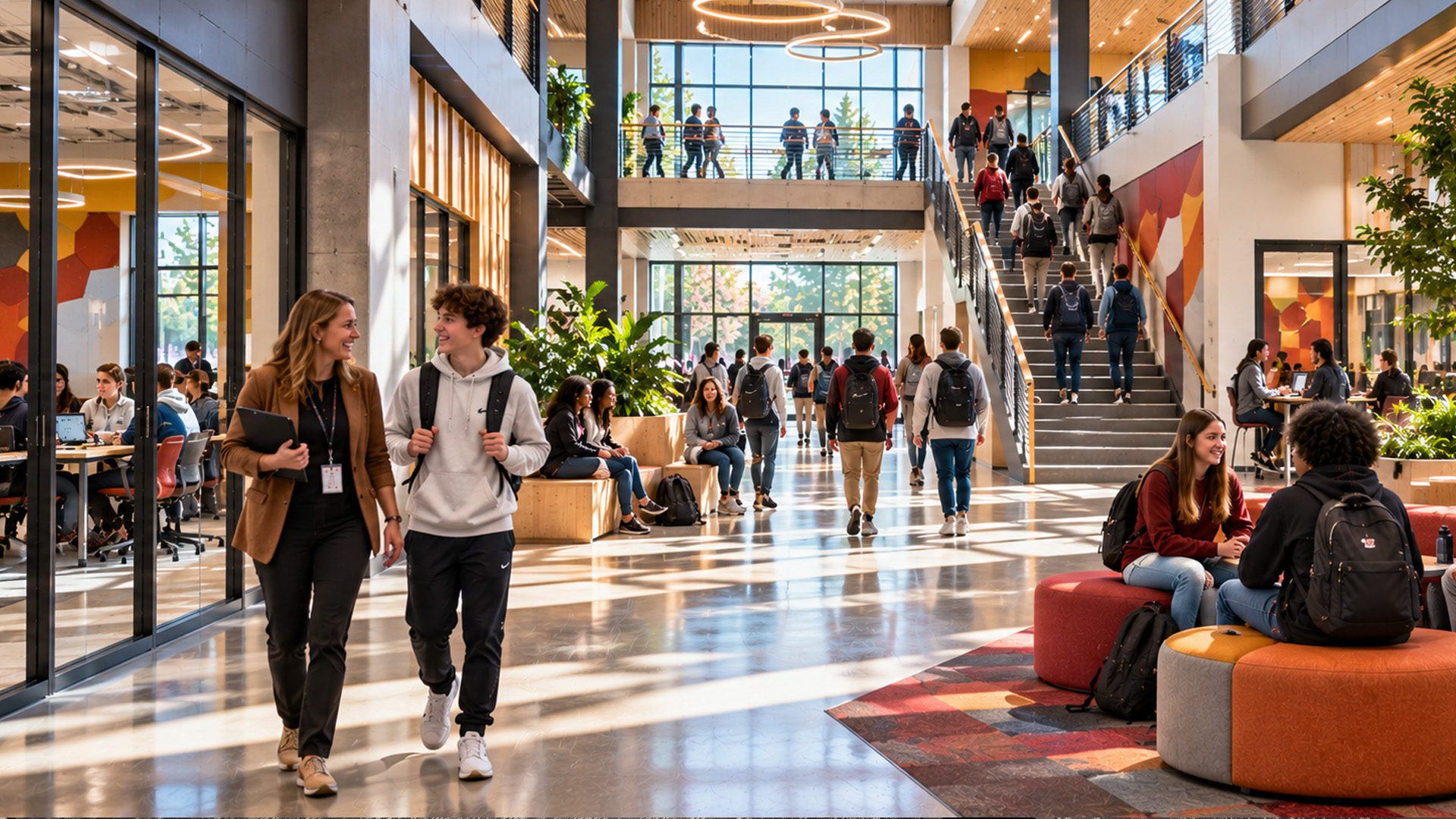
Created to Connect — An Introduction to ProSocial Environments and Experiences
Course Description
The most dangerous school isn’t one with a weak perimeter. It’s one where no adult knows any student’s name.
This course opens the series with a provocative premise: that relationship is the most powerful safety feature a school can have — and that architects are uniquely positioned to design for it. Drawing on ProSocial research and current school climate science, participants explore how the physical environment either supports or erodes the frequency and quality of human connection throughout the school day.
Sightlines, circulation, gathering nodes, transition zones — these aren’t just design choices. They are social infrastructure. When they’re right, they don’t just feel better. They measurably reduce isolation, improve belonging, and build the school cultures where every other safety intervention actually has a chance to work.
This course maps the full arc of the series: trauma-informed design, developmental responsiveness, belonging, security, resilience, and community-centered environments. It all starts here.

Learning Objectives
- Identify the ProSocial framework’s core design principles and the public-health and behavioral research base connecting social connection to occupant health, safety, and welfare in K–12 environments.
- Examine the relationship between belonging, connection, and student success — and how specific built-environment decisions can strengthen or undermine each.
- Explain how social, emotional, intellectual, and physical safety interact in the built learning environment and collectively determine whether students are prepared to engage and learn.
- Analyze how ProSocial design principles translate into measurable design decisions that improve student learning outcomes and long-term community welfare.
Course Credits
1 LU | HSW