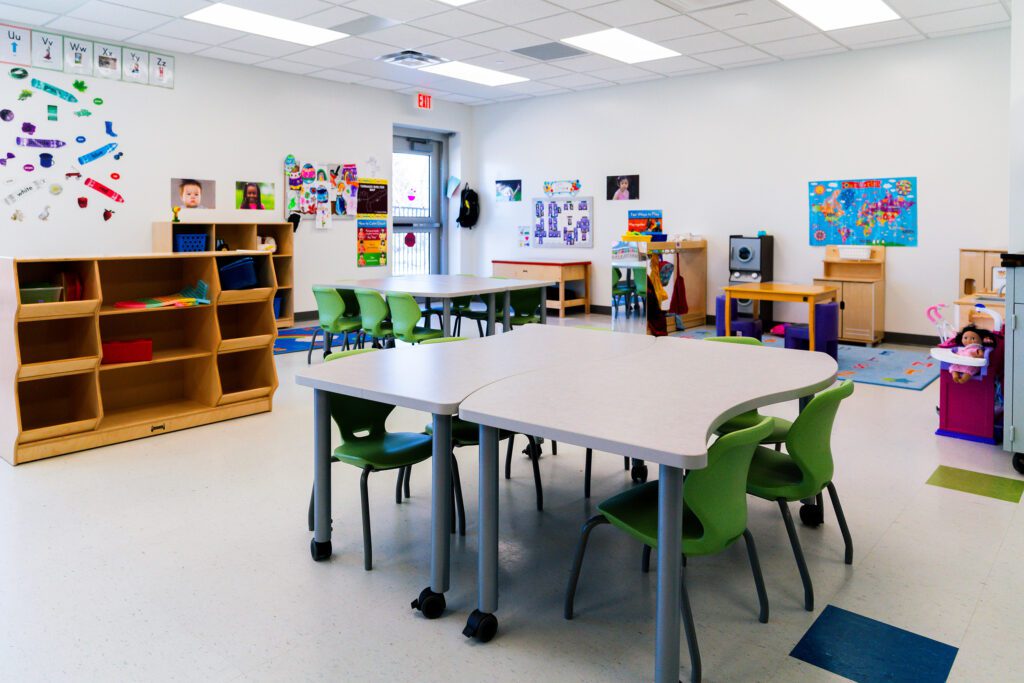
How to Choose the Right School Furniture Company
How to Choose the Right School Furniture Company
For K–12 Superintendents, Principals, Facilities Directors, Chief Business Officers, CTE Directors, and Architects
When the time comes to furnish or refurnish a school, an administrator could be tempted to find the lowest bid. When school budgets are tight, a lower price sticker may be most appealing to the eye.
Cost alone doesn’t define value. An $80 chair replaced every five years rarely outperforms a $150 chair designed to last fifteen.
This guide is for school leaders who want to make smarter, more justifiable decisions about Furniture, Fixtures, and Equipment (FF&E). These decisions can serve students and communities for decades, not just until the next budget cycle.
The Problem with Reactive Purchasing
Many districts take a piecemeal approach to their FF&E purchases based on a classroom’s immediate needs. This reactive cycle results in inconsistent quality across FF&E, higher total costs, and inefficient resource allocation. Unplanned FF&E maintenance and repairs typically cost 25–30% more than those conducted through strategic planning [1].
The effects of being unstrategic manifest in the classroom everyday: in students sitting on worn-out chairs, in desks that can’t be reconfigured for group work, in spaces that no longer reflect how teaching and learning best occur.
A district does not need to spend more money for FF&E. They just need to spend more strategically. It’s a long-term investment that requires intentional management.
Understanding Total Cost of Ownership (TCO)
Total Cost of Ownership is all expenses created by an asset throughout its life. There are four categories to account for:
- Acquisition Costs: Purchase price, delivery, installation, training, and removal of replaced items. These are the most visible costs at the time of purchase, and the ones most likely to determine a decision if TCO isn’t applied.
- Operational Costs: Energy consumption, supplies, space requirements, and staff time.
- Maintenance Costs: Scheduled maintenance, repairs, technical support, and cleaning. These accumulate steadily over an asset’s life and are frequently underestimated at the point of purchase.
- End-of-Life Costs: Decommissioning, disposal, recycling, and transition to replacement solutions. Addressing end-of-life strategies minimizes environmental impact and controls costs [2].
Compare the Numbers
When considering FF&E, total lifecycle cost tells a more complete story than acquisition cost alone. Consider two classroom desks:
| Desk A | Desk B | |
|---|---|---|
| Initial Purchase | $200 | $300 |
| Lifecycle | 10 years | 15 years |
| Annual Maintenance | $20/year | $10/year |
| Total Annualized Cost | $40/year | $30/year |
Multiply this dynamic across thousands of pieces in a district, and the budget implications become monumental.
Three Questions Every Space Should Answer: Functional, Utility, and Replacement Value
To determine whether a space will continue to support learning down the line, Meteor Education uses a three-part framework that asks different questions across distinct timelines: functional value, utility value, and replacement value.
Functional Value: The 3–5 Year Question
The Question: Does this room deliver the capabilities needed to support teaching, learning, and safety requirements over the next 3–5 years?
Functional Value addresses near-term instructional capability. High-quality FF&E provide comfort, collaboration, and adaptability, serving diverse teaching methods and learning needs. Flexible furniture supports modern pedagogies such as group learning and project-based work.
A space that cannot support those modes of instruction is not functional, regardless of how attractive or inexpensive it was to furnish. Functional Value is the threshold question. If a space can’t meet current instructional needs, no amount of long-term planning changes that.
Utility Value: The 10–20 Year Question
The Question: Will this remain a high-use, flexible, and relevant space over the next 10–20 years, or will it become obsolete, locked into one program, or too expensive to adapt?
Utility Value addresses long-term adaptability. A space designed exclusively around a single program — a specific CTE pathway, a particular grade-level configuration, a technology model that may not survive the decade — runs a high risk of turning obsolete. A space that’s modular and flexible retains Utility Value across changes in curriculum, enrollment, staffing, and pedagogy.
Replacement Value: The Budget Cycle Question
The Question: When will this need to be replaced, how will it be funded, and is that plan already built into future budget cycles?
Replacement Value addresses the financial lifecycle of the asset. Every piece of FF&E has a useful life, and every district will eventually face the cost of replacing it. Without a defined replacement schedule, that cost arrives as a surprise, forcing reactive purchasing, the very cycle strategic planning is designed to break.
Furniture begins as a capital asset and gradually shifts to a fully amortized cost over its useful life. Without proactive planning, that transition stays invisible until a classroom suddenly needs to be re-outfitted, often with no dedicated funding in place.
Many districts simply don’t have a replacement plan. A knowledgeable furniture partner can map asset lifecycles against future budget cycles, helping district leaders build a realistic long-term funding strategy instead of absorbing replacement costs as emergencies.
| Functional Value | Utility Value | Replacement Value | |
|---|---|---|---|
| Range | 3–5 years | 10–20 years | Useful life through end-of-life |
| Main question | Does it work for current instruction? | Will it still work as instruction needs change? | When will it be replaced and is it funded? |
| Risk if neglected | Space doesn’t support teaching and learning today | Space becomes obsolete, locked, or too costly to adapt | Unplanned capital needs, reactive purchasing, no funding in place |
| Planning focus | Pedagogy, safety, flexibility now | Modularity, adaptability, program neutrality | Lifecycle scheduling, replacement timing, budget alignment |
The most strategically designed learning environments meet all three standards. They work for teachers and students today, they can be adapted to work for teachers and students a generation from now, and they have a clear replacement plan that aligns with future budget cycles.
What to Look for in a Furniture Partner
Choosing the right partner is as important as choosing the right furniture. Here is what to evaluate at each stage of the relationship:
- Collaborative Design Process
- Manufacturer Network and Product Access
- Safety Certifications: BIFMA Compliance
- Purchasing Contracts
- Post-Installation Support and Training
1. Collaborative Design Process
A strong partner brings experienced interior designers and educators to the planning process. These are the professionals who understand how pedagogy shapes space requirements.
Meteor Education employs this collaborative approach as a core service, working directly with district teams to develop custom learning environments aligned to academic goals. Their proprietary Current Environment Assessment establishes a baseline for how existing spaces are performing before advising administrators on the best asset investments to make.
2. Manufacturer Network and Product Access
A partner working with a wide manufacturer network provides access to a broader range of solutions than a single-brand vendor. This matters both for initial design flexibility and for long-term asset management: access to replacement parts, compatible product lines, and updated models across an asset’s useful life is significantly more reliable when a partner maintains broad market relationships. Meteor Education works with more than 240 manufacturing partners. Wholistic selection processes look beyond purchase price to consider:
- Product quality
- Warranty coverage
- Availability of parts
- Company stability
- Sustainability practices
3. Safety Certifications: BIFMA Compliance
School furniture should meet the standards established by the Business and Institutional Furniture Manufacturers Association (BIFMA), the leading industry body for safety and durability testing in commercial and institutional settings. BIFMA certification provides independent verification that a product can withstand the demands of K–12 use [3]. BIFMA Compliance should be a requirement in any procurement process.
4. Purchasing Contracts
Cooperative purchasing contracts through organizations like Omnia, Equalis, TIPS, and state-level co-ops allow districts to procure FF&E at pre-negotiated pricing without a separate competitive bid process. Cooperative purchasing agreements enable districts to benefit from bulk pricing and shared resources. Working with a partner who participates in established co-op programs streamlines procurement, reduces administrative burden, and ensures pricing accountability [2].
What Good Vendor Partnerships Deliver
Strategic vendor relationships extend beyond transactional purchasing to create partnerships that deliver greater value throughout the FF&E lifecycle.
Long-term vendor relationships ensure consistent quality and reliable service. A long-term vendor will often deliver greater value than continual rebidding through:
- Service level agreements with clear performance expectations
- Collaborative planning involving key vendors in long-term discussions
- Shared risk approaches such as performance-based contracting [2].
Vendor partnerships create consistency, accountability, and enduring value, yielding significant benefits in pricing, quality, and support that one-off contracts often fail to achieve.
| Transactional Vendor | Strategic Partner |
|---|---|
| Focused on individual purchases | Involved across the asset lifecycle |
| Price-driven selection | Value-driven selection |
| No post-installation role | Post-installation training, support, impact measurement |
| Limited manufacturer access | Broad manufacturer network |
| Reactive to district requests | Proactive planning and support |
The Bottom Line
Upfront price is only the beginning. The school leaders making the best long-term decisions are the ones asking three questions before any purchase:
- What will this actually cost over its useful life?
- Will this space still be working for students and teachers 10-20 years from now?
- When will this need to be replaced, how will it be funded, and is that plan already built into future budget cycles?
With thoughtful implementation, FF&E becomes an asset that supports sustained district success.
The framework exists. The tools exist. The right partner can walk you through both.
For districts ready to transform their learning spaces, connecting with a local Meteor Education studio is the first step toward turning vision into measurable impact.
Frequently Asked Questions
Look beyond the initial purchase. The right partner supports the full lifecycle of your investment, from educator-led design and installation through post-installation teacher training and outcome measurement. A company that only delivers furniture is not the same as one that helps districts prove ROI to their school boards.
Start with BIFMA certification, which independently verifies that products meet safety and durability standards for K-12 use [3]. From there, ask about warranty terms, replacement part availability, and manufacturer access. A partner with a broad manufacturer network can match any budget to a durable, certified solution.
Yes. The key is applying a total cost of ownership lens rather than defaulting to the lowest bid. Phased rollouts, cooperative purchasing contracts through organizations like Omnia, Equalis, and TIPS, and a partner with access to 240+ manufacturers all help districts get budget-friendly, high-quality solutions without sacrificing instructional impact.
Ready to transform your existing space into a dynamic learning hub that engages every student? Contact the K-12 learning environment experts at Meteor Education today to start a conversation and bring your vision to life.
Sources:
[2] MeteorEducation internal data
Get in touch
Find Your Local Studio
Meteor Education partners with schools to create collaborative spaces that accelerate engagement and empower educators.