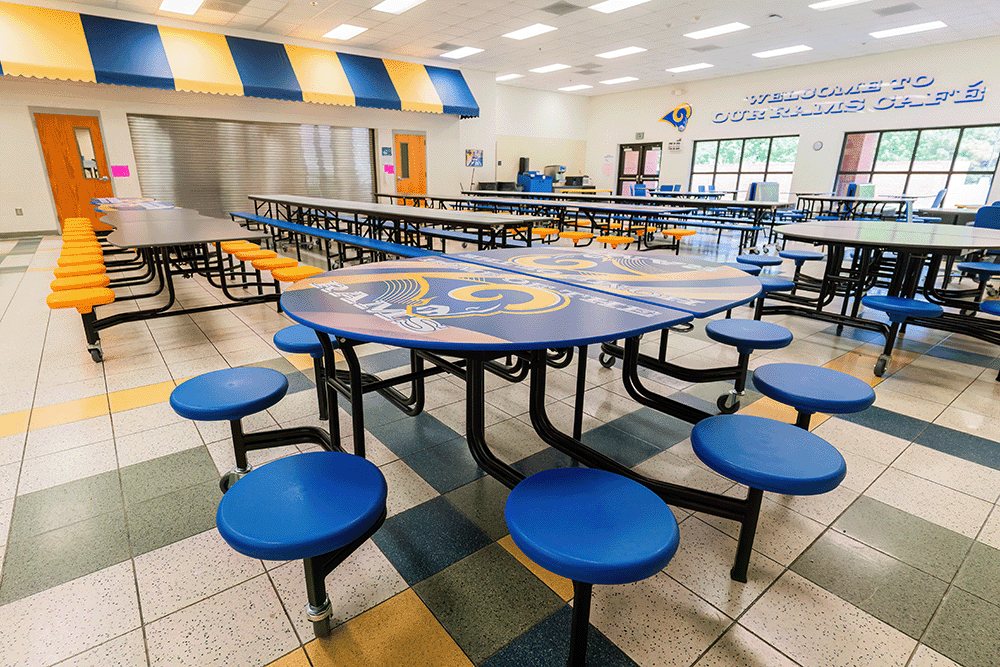
Designing a School Cafeteria That Works for Every Student
The school cafeteria has always had a job to do: get students fed, move them through, then get them back to class. For decades, that was enough, and the physical spaces reflected it. Functional, if nothing else.
But the cafeteria was never just a place to eat. It’s where students decompress between classes, find their people, and spend one of the few unstructured moments of their school day. For many, it’s one of the most socially significant spaces in the building. Yet it’s rarely designed with that in mind.
The cafeteria is one of the most socially significant spaces in a school. It’s rarely the most intentionally designed.
So what does it take to design a cafeteria that actually works? The answer starts with understanding why so many cafeterias fall short, and how the right furniture and design choices can bring a welcoming sense of identity to these high-traffic environments.
More Than a Place to Eat
The cafeteria is one of the few spaces in a school that every student passes through, every day. That consistency makes it much bigger than a dining room. For many students, lunchtime is the social and emotional hinge of the school day. It’s a moment to reset and simply breathe before the afternoon begins.
That kind of experience doesn’t happen by accident. Environment shapes behavior, and a school cafeteria that feels neglected or unwelcoming sends a message to students about how much the space — and by extension, they — are valued. However, the inverse is also true.
When the environment signals that students matter, they act like it.
At Chesterfield County Schools, where cafeterias were refreshed across all sixteen campuses, staff noticed the impact right away. Lunch counts went up. The space had become somewhere students actually wanted to be. “It makes them feel safe,” said Lisa Baker, Food Service Admin Assistant. “It’s like they’re at home.”
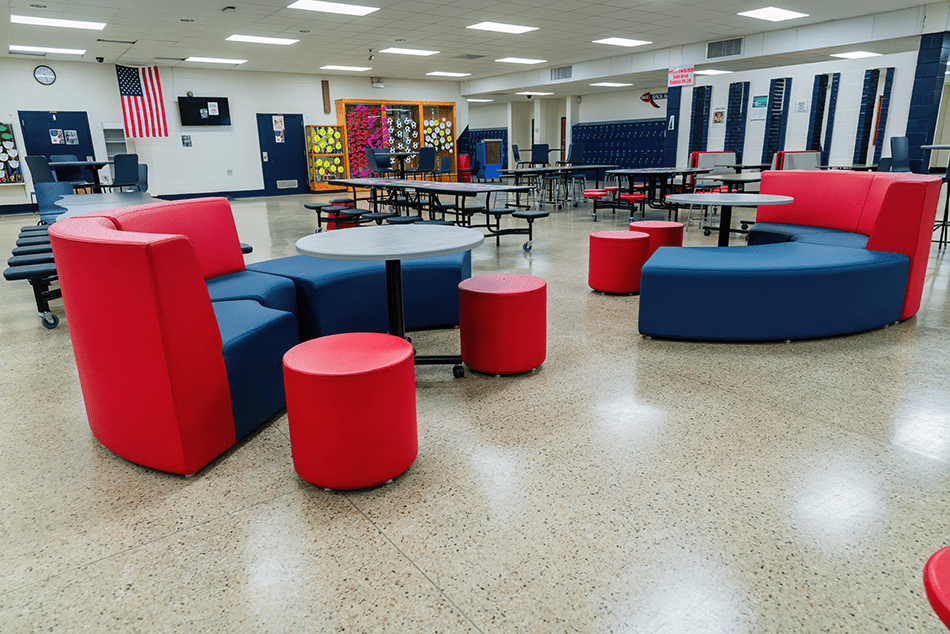
That’s the opportunity. And it starts with an honest look at where most cafeterias currently stand.
The State of the School Cafeteria
Many school cafeterias are running on decades-old infrastructure. The furniture that was installed when the building opened is often still there. Worn down, mismatched, and in some cases literally falling apart.
District leaders in Chesterfield estimated some furniture was close to twenty or thirty years old. As CFO Kevin Caskey described it, “You’d walk in there and it’s like you’re walking into the early 90s or late 80s.” Seats were breaking off. Students were balancing on damaged chairs just to eat lunch.
That level of deterioration may be an extreme example, but the underlying pattern is common. Cafeterias tend to get deprioritized in renovation cycles, squeezed out by classroom & technology upgrades and more visible facility needs. The result is a space that hasn’t kept pace with the rest of the school.
The school cafeteria is often the last space to be updated, and students notice.
The consequences show up in participation. When a cafeteria feels uninviting, students opt out, bringing food from home or skipping lunch altogether. Low participation creates a ripple effect:
- Meal program funding, which is often tied to participation rates, takes a hit
- Food waste increases as fewer students choose the hot lunch option, a problem that costs U.S. schools an estimated $1.7 billion annually
- Students push through their afternoons without a proper meal
The physical environment isn’t the only factor in participation, but it’s one of the few that schools can directly control. And unlike curriculum changes or staffing decisions, improvements to the cafeteria environment can produce visible results quickly, often without a full renovation.
Furniture That Fits the Space and the Students
Furniture is one of the most powerful levers a school has when it comes to improving the cafeteria experience. It doesn’t require construction and it can be introduced in phases. More importantly, finding the right mix of seating can impact how students use the space.
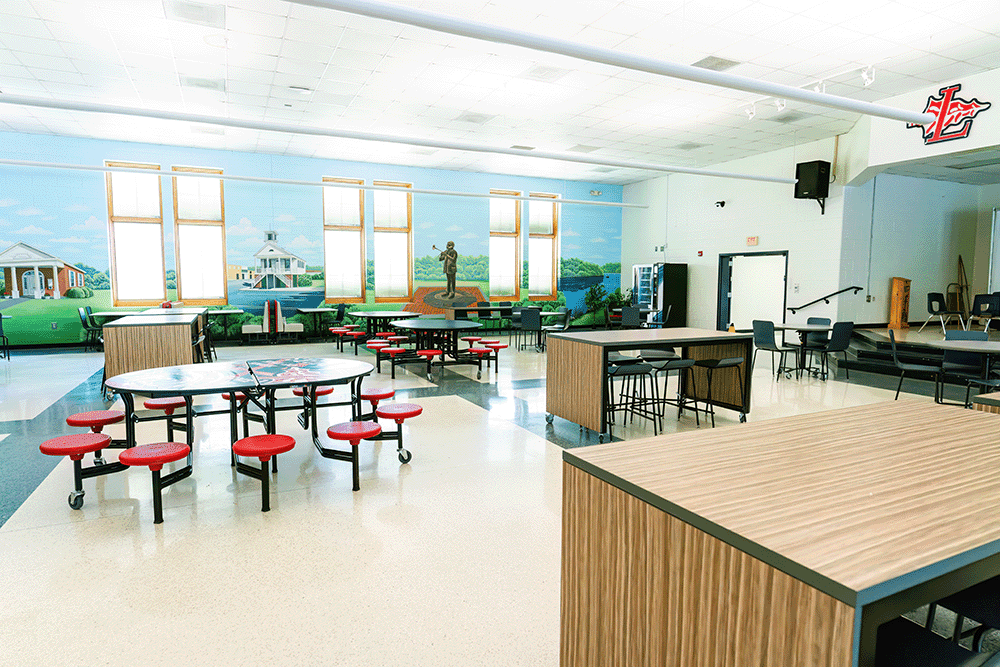
Most older cafeterias default to one seating type: long bench tables, fixed in rows, designed to pack in as many students as possible. That approach prioritizes capacity over experience, and it shows. Students who don’t feel comfortable in the space find ways to avoid it.
A more intentional approach introduces variety:
| Seating Type | Why It Matters |
|---|---|
| Round Tables | Encourage conversation and work naturally for group dynamics, making lunch feel more social and less institutional. |
| Booths | Offer a semi-private option for students who want a quieter, more contained experience. |
| High-Tops | Bring an aspirational feel to the space, particularly at the secondary level. |
| Traditional Bench Tables | Still have a place, especially at the elementary level, but work best as one option among several. |
Chesterfield’s introduction of high-tops was a particular hit with secondary students, who described them as giving the cafeteria a “college-type feel.” That kind of reaction points to something broader — when students see furniture that signals the space was designed with them in mind, they respond to it differently.
When students see seating designed for them, they use the space differently.
Beyond seating variety, a few practical considerations should guide every cafeteria furniture decision:
| Consideration | Why It Matters |
|---|---|
| Age-Appropriateness | Seating that works well for a high schooler isn’t necessarily right for a third grader. Cafeterias that serve multiple grades need furniture that reflects the range of students using it. |
| Durability | Cafeteria furniture gets heavy daily use. Commercial-grade materials are a practical investment that holds up over time and reduces replacement costs. |
| Flexibility and Mobility | Furniture that can be easily reconfigured or moved supports everything from different group sizes day-to-day to full room resets for assemblies and events. |
The good news on budget: schools don’t need to replace everything at once. Introducing even one or two new seating types alongside existing furniture can meaningfully shift the feel of the space and signal to students that the environment is evolving.
A Space Students Can Call Their Own
The right furniture goes a long way, but it alone doesn’t make a cafeteria feel like home. Most school cafeterias are interchangeable. You walk into one and it could be any school in the country. School-specific branding changes that.
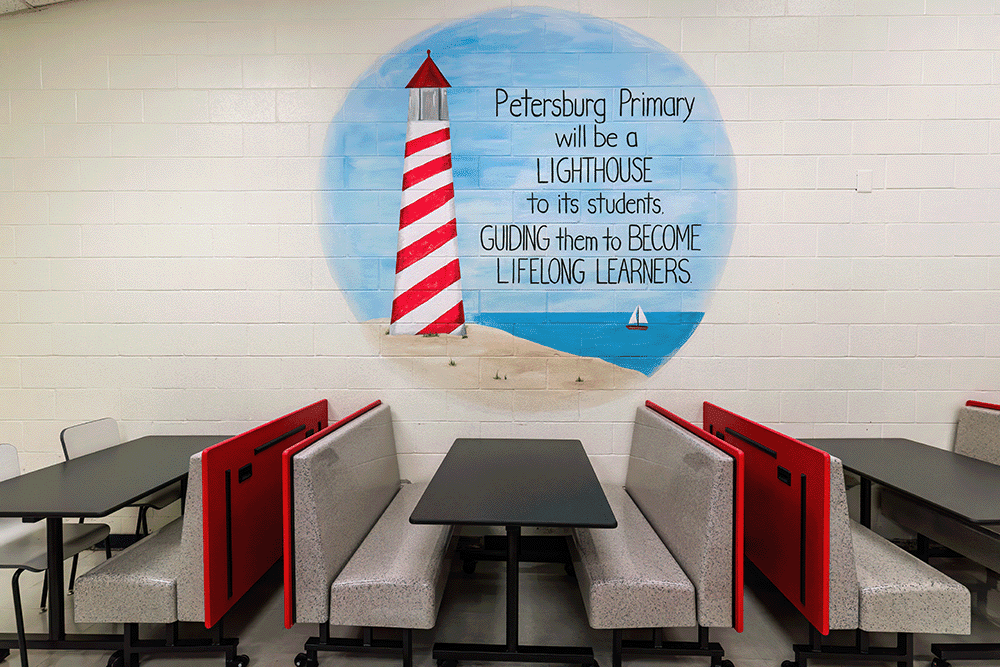
Colors, logos, and murals turn a generic dining space into one students recognize as theirs, and students who feel a sense of ownership over their environment tend to treat it differently.
School-specific design turns a generic dining space into one students recognize as theirs.
Custom logos and murals were part of every campus renovation in Chesterfield. District leaders noted it was now immediately obvious which school you were walking into, something that hadn’t been true before.
That sense of place doesn’t require a full overhaul to achieve. Even small, deliberate choices add up to a space that feels intentional.
Conclusion — School Cafeteria Design
The school cafeteria has always been important. It just hasn’t always been treated that way. When it’s designed with intention, it stops being purely functional and starts being genuinely good for students. The investment doesn’t have to be all-or-nothing. It just has to start somewhere.
MEteor Education
Ready to upgrade your school cafeteria?
Explore furniture and design solutions built for modern school dining.