Empowered Learners: How Classroom Environments Spark Student Ownership
Student agency — the ability for learners to choose, create, and take ownership of their learning— is emerging as one of the most critical future-ready skills. In a rapidly changing economy shaped by automation and AI, agency equips students with in-demand skills such as analytical thinking, adaptability, leadership, and creativity. Core attributes of agency, including voice, choice, ownership, self-regulation, motivation, and influence, are strengthened through the learning environment, where flexible, student-centered spaces foster autonomy, collaboration, and authentic decision-making.
Enhancing Student Agency in Learning Environments
The classroom environment is a way for students to demonstrate agency. Vander Ark (2025) notes, “Learning environments that value curiosity, enable voice and choice, and empower personalized pathways develop students’ agency and related dispositions of efficacy, self-determination, and adaptability” (p. 43).
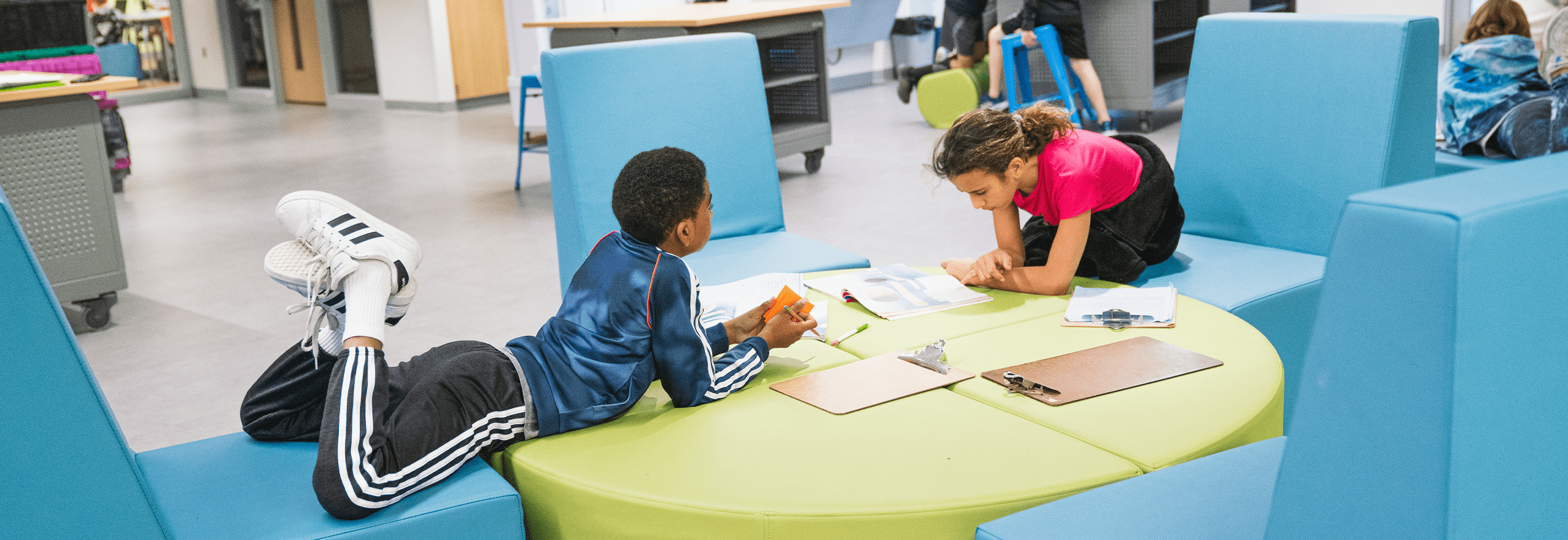
Research comparing traditional classrooms with flexible learning spaces reveals that adaptable, student-centered environments increase active engagement (Kariippanon et al., 2019). In these spaces, students spent more time collaborating, interacting, and presenting work while fostering autonomy and reducing off-task behaviors.
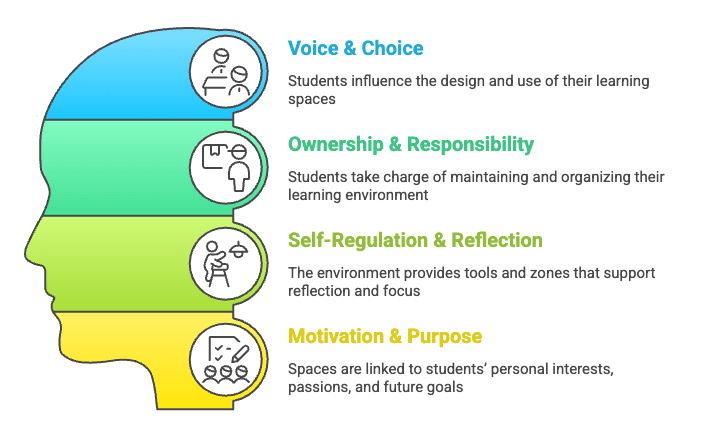
Through the elements of student agency, students can demonstrate agency as noted in the examples below.
| Voice & Choice | Students influence the design and use of their learning spaces. |
Examples of Student Agency in the Classroom
- Students vote on flexible seating arrangements (e.g., couches, floor cushions, desks).
- Floor seating, wobble chairs, and standard chairs are available for students to select, depending on their comfort and learning needs.
- Classroom supplies are organized in ways that students can access what they need without asking permission and can select supplies to suit their learning preferences.
| Ownership & Responsibility | Students take charge of maintaining and organizing their learning environment. |
Examples of Student Agency in the Classroom
- Students participate in arranging or rearranging the classroom for different activities, lessons, or projects.
- Students help map learning zones or measure stations to evaluate how the environment supports engagement and collaboration.
- Students propose and implement changes to the classroom layout or organization to improve flow, accessibility, or comfort for themselves and peers.
- Classroom “tech captains” or “materials managers” ensure tools are ready for peers.
| Self-Regulation & Reflection | The environment provides tools and zones that support reflection and focus. |
Examples of Student Agency in the Classroom
- Students choose to work in “quiet corners” or “collaboration zones” based on their needs.
- Students take ownership of bulletin boards, progress charts, or reflection walls to represent learning, set goals, or share work. On “wonder walls”, students post questions or insights.
- Students help design spaces for mindfulness or “reset” areas to manage emotions.
| Motivation & Purpose | Spaces are linked to students’ personal interests, passions, and future goals. |
Examples of Student Agency in the Classroom
- Students design bulletin boards to display class work or community issues they care about.
- Passion project corners store ongoing independent projects
- Career pathway walls display student-created projects aligned to aspirations.
Agency Starts Here: Shaping Learning Through Space
Student agency is strengthened when the classroom environment is designed to support autonomy, collaboration, and purpose. When learners shape how their environment looks and functions, manage materials, select work zones, and contribute to classroom design, they practice core attributes of agency such as voice, ownership, motivation, and reflection. By intentionally designing environments that empower students to influence and navigate their learning space, educators cultivate the confidence, adaptability, and future-ready skills essential for success.
Unlock Agency in Every Learning Space
Want to go beyond participation and foster true autonomy? We’ll help you create spaces where students lead, collaborate, and own their learning experience.
About the Author

Rebecca Stobaugh, Ph.D., is a Learning Experience Strategist for Meteor Education, where she partners with schools to design innovative learning environments that foster student agency and engagement. A former middle and high school teacher, professor, and instructional coach, she brings deep classroom and leadership experience to her work with districts nationwide. Rebecca has authored multiple books on critical thinking and instructional design, and she is passionate about helping educators create future-ready learning experiences that prepare students to thrive in a complex world.
Kariippanon, K. E., Cliff, D. P., Lancaster, S. J., Okely, A. D., & Parrish, A.-M. (2019). Flexible learning spaces facilitate interaction, collaboration and behavioural engagement in secondary school. PLOS ONE, 14(10), e0223607. https://doi.org/10.1371/journal.pone.0223607PLOS+2ResearchGate+2
Vander Ark, T. (2025, July 1). Why learner agency is more important than ever. ASCD Educational Leadership, 82(9).