Design First, Spend Smarter: How Learning Environment Design Aligns Goals and Budgets
Major learning environment projects (new schools, bond-funded renovations, CTE expansions, or next-generation classrooms) carry big expectations.
But budget overruns often don’t come from one bad decision. They come from budget creep: small, well-intended choices made across dozens of spaces that quietly push the project out of alignment.
This article explains why budget problems typically start long before purchasing and outlines how intentional learning environment design helps districts prevent late-stage redesign and disappointment by establishing clear transparency early in the process. You’ll learn how to keep learning goals, design decisions, and budgets aligned from day one, so the project delivers what was promised, within the budget the community approved.
What you’ll get out of this article:
- Why budget problems usually start before purchasing and how misalignment creates hidden cost overruns
- How “budget creep” happens in space-by-space design and why it often becomes a trust problem, not just a numbers problem
- The most common early pitfalls (including brand decisions that break the budget)
- Why the best cost-control move is simple: start with instruction, not inventory
- How intentional design protects long-term value by right-sizing spaces, avoiding underused upgrades, and planning for lifecycle durability
Design First, Spend Smarter: How to Align Learning Goals and Budgets from Day One
A bond finally passes. Years of planning turn into green lights. The community is excited and watching because this might be the first new school, renovation, or major learning investment in a generation.
And then the project gets real.
Not just in vision statements, but in the decisions that follow. What are we actually putting in these spaces? What will classrooms look like? What will labs enable? What will the learning environment make easier, or harder, every single day?
Sometimes it’s a big capital project like this with years in the making. Other times it’s more targeted but just as significant: a new CTE pathway you’re launching, or a next-generation classroom meant to model the future of student skills and workforce readiness.
Either way, the stakes are high. Because a learning space isn’t just a place to sit. It shapes behavior. It shapes engagement. It shapes what students believe is possible.
And keeping the promise of that investment requires more than good ideas. It requires disciplined learning environment design that aligns learning goals, design decisions, and budget realities from day one.
Once the project begins, expectations rise quickly. And those expectations translate into hundreds of decisions:
- What should classrooms look like and how should they function day to day?
- How should students collaborate, create, and work independently?
- What technology truly needs to be integrated (and what doesn’t)?
- How should spaces support inclusion, student behavior, and belonging?
- What do teachers need for new methods of instruction?
But because as the work moves from big-picture vision to space-by-space design, it becomes easy to lose strategic altitude — the ability to see how a series of small decisions affects the total budget and final delivery.
And that’s exactly how budget creep starts.
The Hidden Risk: Budget Creep and Disappointment
Budget challenges rarely show up all at once. More often, they sneak in early, like a small leak you don’t notice until there’s water pooling on the floor.
It often begins innocently: a reasonable upgrade in one room. A small addition in another. A tweak meant to support a program or teacher need. Each decision feels justified in isolation.
But without strong guardrails, those decisions stack up. And the result isn’t just a spreadsheet problem. It becomes a trust problem.
Because when costs rise late in the process, districts are forced into redesign, pulling back on plans that were already shared, already celebrated, and already emotionally “owned” by teachers and stakeholders who invested time shaping the future vision.
That’s when disappointment sets in.
Educators who were energized early and excited to help shape the future of learning are asked to compromise on features they believed were settled. Leaders face difficult tradeoffs under pressure. Communities wonder why the promise feels smaller than what they imagined.
And often, everyone is left thinking: How did this happen?
The Responsibility: Manage Expectations with Guardrails
When a district launches a new school or major renovation, the responsibility isn’t only to design inspiring spaces, it’s to manage expectations with integrity.
That means aligning three realities from day one:
- What learning goals require
- What the design can deliver
- What the budget can actually support
To do that, districts need more than good intentions and good ideas. They need a disciplined process that creates transparency early so budget shifts become strategic decisions, not accidental drift.
Why Budget Problems Usually Start Before Purchasing
Budget issues rarely come from one bad decision. They come from learning environment design choices that weren’t aligned early enough to guide hundreds of downstream decisions.
Common pitfalls tend to look like this:
- Shopping for products before defining instructional needs
- Designing spaces around what’s available instead of how they’ll be used
- Solving isolated problems without a long-term plan
- Falling in love with a specific brand before confirming it fits the full project budget
That last one happens more than most districts expect.
A brand may look amazing in the renderings. It may have a strong reputation. It may feel like the “right” choice for a flagship project. But if that selection pushes the project out of alignment, even by a little, it often forces painful tradeoffs later: scaling back other spaces, redesigning layouts, or compromising on the very outcomes the project was meant to deliver.
In other words: a beautiful solution that breaks the budget isn’t really a solution; it’s a future redesign.
The key is protecting alignment, not avoid quality. Because there are almost always multiple ways to solve for the function of a space. And districts tend to make smarter decisions when they work with partners who can offer a broad range of price points, manufacturers, and design options, ensuring the widest selection to meet needs without locking into a single brand or price tier too early.
Learning goals, space design, and purchasing decisions function as a connected ecosystem, each informing and affecting the others. When they aren’t aligned early on, districts often spend more correcting issues later: adding furniture, reconfiguring layouts, or replacing pieces that never quite fit the need.
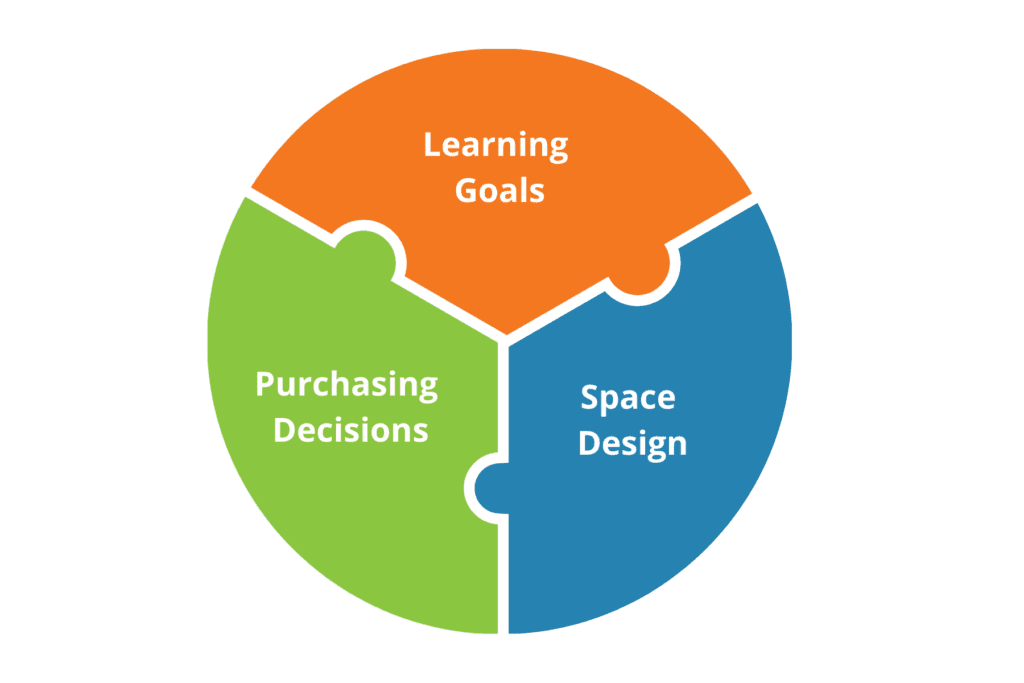
Thoughtful planning at the outset helps avoid those course corrections altogether, keeping projects focused, efficient, and on track.
Start with Instruction, Not Inventory
The most cost-effective projects begin with a simple shift: treating learning environment design as a way to support how learning happens, not just what needs to be purchased.
Early planning works best when teams step back and ask:
- What are we asking students to do most often in this space?
- How does the space need to shift throughout the day and how quickly?
- Where do teachers and students currently experience friction in the layout?
Designing around real classroom use ensures spaces naturally support instruction. Teachers spend less time adapting the room. Students engage more easily with their environment. And when design decisions are rooted in instruction, purchasing becomes far more efficient.
Using Design to Control Costs
Learning environment design is a creative exercise, but it’s also one of the most powerful cost-control tools districts have.
Intentional design helps districts:
- Right-size spaces instead of over-building or over-furnishing
Designing spaces around how many students actually use them (and how often) helps avoid overcrowding rooms with furniture that limits flexibility or goes unused. - Avoid underused products that look good but don’t support daily learning
Thoughtful planning helps districts steer clear of single-purpose pieces or trend-driven upgrades that rarely get used once the novelty wears off. - Plan for durability and lifecycle value, reducing replacement costs over time
Selecting well-made, adaptable furniture with long-term use in mind reduces replacement cycles and stretches budgets further over time.
Rather than defaulting to more furniture or specialized solutions, design helps clarify what’s truly necessary and what isn’t. The result is a budget that supports learning goals without carrying excess.
Smarter Planning, Stronger Outcomes
When learning goals lead, every dollar works harder to support student outcomes.
Projects tend to get more complicated — and more expensive — when decisions are made in isolation. But when districts start with instruction and use learning environment design as a guide, spending becomes more focused and far less reactive.
The result is better cost control and, most importantly, better outcomes. Spaces work the way they are intended to, investments last longer, stakeholders stay aligned, and progress happens even when funding is limited.
Meteor education
Not sure where to start when planning your next project?
Our collaborative design process helps clarify priorities before budgets are locked in, establishing guardrails that keep learning goals, design decisions, and purchasing aligned.
Frequently Asked Questions
How can districts improve learning spaces with tight budgets?
Districts can prioritize high-impact updates, reuse what already works, and phase improvements over time. A clear design vision helps ensure each investment builds toward long-term goals, even when funding is limited.
Do effective learning spaces always require bigger budgets?
No. Effective learning spaces are driven by intentional design decisions, instructional alignment, and flexibility. Thoughtful planning often delivers greater impact than higher spending alone.
What makes a classroom design effective for teaching and learning?
An effective classroom design starts with understanding how the space will be used and then designing around those needs so teaching and learning can happen smoothly throughout the day.
How can schools upgrade classrooms with limited funds?
Schools can upgrade classrooms with limited funds by focusing on design decisions before purchasing, phasing improvements over time, and working with partners who collaborate directly with manufacturers to identify cost-effective solutions that maximize value.
Why is instructional alignment important in learning space design?
Instructional alignment ensures that classrooms and shared spaces support daily teaching practices rather than forcing workarounds, making learning environments easier to use, more engaging, and more effective.